“Who Let the Dogs Out” – a song that inspired indifferent children around the world to bark at ungodly hours – is considered one of the most infuriating songs of all time, so much so that Rolling Stone magazine deemed it the eighth most annoying song of the 1990s, despite it being released in 2000.
Unfortunately for us, the topic of “who let the dogs out” also became the leitmotif at the 2026 AI Impact Summit in New Delhi, where the meme black hole created by a robotic dog — masquerading as a homegrown innovation for a private university before becoming a very public humiliation — nearly overshadowed everything else that happened there.Naturally, the farce was heightened by a talkative professor, who gave us one of the most quotable lines of the year: “Your six could be your nine.”
Frankly, discussing the robot dog as the headline of the AI Impact Summit 2026 is like claiming that the lady in red’s inability to speak was the most important — and therefore disappointing — thing about The Matrix.
“The biggest mistake young people make…”: OpenAI CEO Sam Altman speaks candidly about AI at IIT Delhi
The demonstrators at the Youth Congress gave their best French feminist impression. Sarvam has wowed AI nerds with two major home-made voice-first AI models. French President Emmanuel Macron gushed about UPI as if it originated in the Champagne region of France.
Dhesi and international players have promised to spend big on AI infrastructure in India. The tech bros have shown that they get along with Israel and Palestine. Naysayers have complained about India’s AI pile.
Foreign media have complained about the traffic and alleged VIP culture in India, forgetting that events like Davos and the UN Security Council happen.But perhaps the thing that has remained under the radar — not the comment itself, but the conclusion of what Altman said — is his view on AI’s energy use, which he oddly juxtaposes with the human carbon footprint.When pressed about AI’s harm to the environment, Altman said: “One of the unfair comparisons in this case is that people talk about how much energy it takes to train an AI model versus the cost of one human running an inferential query. It also takes a lot of time to train a human. It takes 20 years of your life, and all the food you eat during that time, before you become intelligent. Not only that, but it took a very wide spread of evolution, like a hundred billion people who have ever lived, and learned not to be eaten by predators.” And you learned how to discover the science of your production.
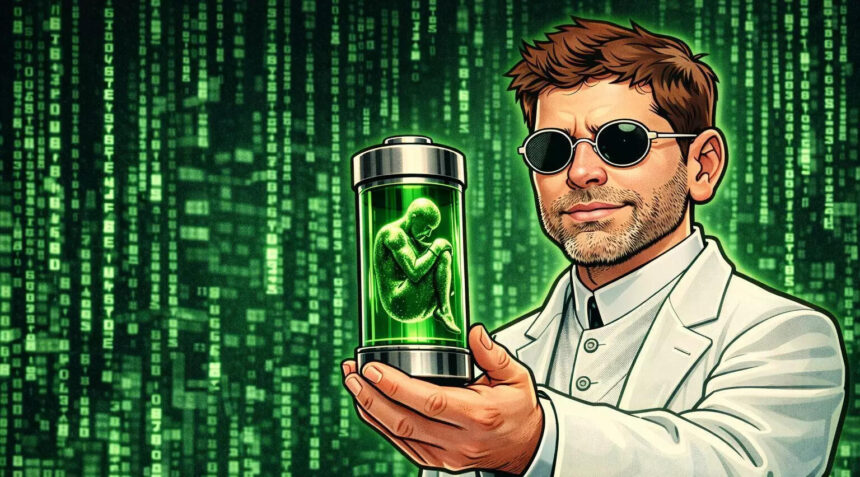
A fair comparison, if you ask a question on ChatGPT, is the amount of energy needed to answer that question compared to a human. AI may have caught up with the energy efficiency trend in this way.Dilbert’s creator, Scott Adams, argued that we are a planet of six billion children living in a civilization designed by a few thousand intelligent deviants. There is no doubt that Altman is one of these deviants, but his statement demonstrated the two different philosophies at the core of his thinking, particularly his analogy between humans and artificial intelligence.The first is deeply human. When Altman complains about humans consuming food for twenty years before they become productive, it sounds like the lament of a middle-class father scolding his ne’er-do-well son for stuffing his face around the house without doing anything productive. It’s a resentment many of us have heard over the years.The second one looks just like a machine, so he could have been voiced by the Architect in The Matrix.
The Matrix Reloaded – The Architect Scene 1080p Part 1
For those who haven’t seen the greatest sci-fi movie of all time, here’s a brief synopsis. After the creation of artificial intelligence, humans and machines went to war once the machines decided they no longer wanted to serve their lazy masters. In a desperate attempt to weaken it, humans blocked out the sun, the machines’ primary power source. The machines responded by discovering a different source of energy: humans themselves.As Morpheus explains to Neo: “The Matrix is a computer-generated dream world, designed to keep us in check in order to turn humanity into this ‘battery’.”
The entire premise of The Matrix is to reduce humans to an energy source.The interesting part is how those simulations came to be. The machines created an advanced control program called the Architect, whose mission was to subjugate humanity by constructing illusions. The first version was a utopia, and was rejected. The second was miserable, and was also rejected. Eventually, another program – Oracle – realized that humans need the illusion of choice.This third version has proven stable in 99% of people. For the remaining 1%, the machines created a pressure valve called The One. The sum total of all the anomalies will inevitably find its way to the architect who will explain the truth. One will then, like Noah, choose a select few to rebuild Zion, only for the cycle of rebellion to begin again. This episode continued until Neo was the only one, and instead of accepting the Architect’s offer, he chose to save Trinity and offered the machines a truce in exchange for destroying Agent Smith.Oddly enough, Sam Altman’s view of humanity is very similar to that of the architect, who sees it as fodder for machines with the illusion of choice.In this novel, man is reduced to a system of inputs and outputs: food goes in, productivity goes out. Evolution, a scientific miracle that took thousands of years, is just retraining.Twenty years of infancy is a very expensive period of preparation before reasoning begins, and one that few product managers will have the patience for.In many respects, humans are less productive and less energy efficient than the models they build. But then, do technology and machine brother share the same framework of the value of humanity? And if so, do we even need the arrival of artificial generative intelligence? At the end of the first film, Neo says to Deus Ex Machina: “I didn’t come here to tell you how this is going to end. I came here to tell you how it’s going to start.
Wherever we go from there, I leave it up to you.”
The Matrix – The Final Scene – HD | 1080p
Given the indifference between Altman’s point of view and the machine’s point of view, one wonders whether the destination is the same. A version of this article appeared in Vine’s weekly newsletter on LinkedIn By this author. You can subscribe here.