

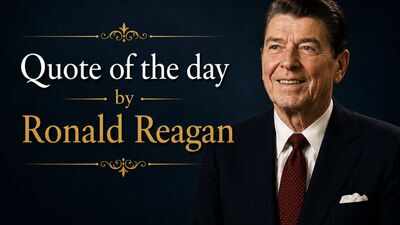
Quote of the Day by Ronald Reagan (Image generated by artificial intelligence)
Two hundred Rangers climbed a steep French cliff under gunfire on June 6, 1944, to eliminate German gun emplacements above Omaha Beach. Forty years later, Ronald Reagan stood on the same cliff, Pointe du Hoc, to mark the anniversary, and it is here that the Reagan Presidential Library places the origin of one of his most frequently repeated phrases about leadership.
“The greatest leader is not necessarily the one who does the greatest things,” he said. “He’s the one who makes people do the greatest things.” The location was not accidental. He was standing in front of veterans who had done the actual climbing, the actual fighting, as he talked about the leadership required of the people who sent them there.
Quote of the day by Ronald Reagan
“The greatest leader is not necessarily the one who does the greatest things, but rather the one who makes people do the greatest things.”
The battlefield beyond words
Reagan delivered this line as part of his remarks marking the 40th anniversary of the Normandy invasion, addressing the same guardsmen who carried out the attack on Pointe du Hoc in 1944.
The speech is remembered mainly because it paid tribute to the soldiers themselves, detailing their sacrifices. This very sentence is contained within the same title, drawing a line between the people who actually stormed the cliffs and the leadership that had to organize, motivate and direct an operation of this magnitude without ever picking up a gun.The setting dramatically increases the sharpness of the point. Reagan was not presenting an abstract theory of boardroom management.
He stood before the actual people whose actions had led to the success of the invasion, publicly crediting them with greatness while assigning leadership a narrower, more specific role: creating the conditions that would allow others to accomplish something extraordinary.The broader D-Day operation involved landing approximately 156,000 Allied troops across five beaches in a single morning, coordinated across multiple nations, branches of the military, and languages.
No commander could physically storm every beach or scale every cliff by himself. The entire operation relied on a series of people trusting orders, trusting each other, and choosing to advance under fire because they believed the effort was important.
Regan’s quote was directly describing that series, as he was standing his ground as one of its episodes was severely tested.
Understand the meaning of Ronald Reagan’s quote
This quote differentiates between two very different types of achievement.
One is to do something cool yourself. The other is to arrange circumstances so that a large group of other people do great work, often without any of them realizing the magnitude of what they have collectively achieved.Reagan believes that the second type is the rarest and most valuable form of leadership. Any reasonably capable person can achieve an individual feat given enough skill and effort.
Getting an entire group of people, each with their own doubts, motivations, and constraints, to move together toward something really difficult requires a completely different set of abilities: communication, trust, and the discipline to stay out of the way once the direction is set.This is also a quote about where credit is. It would have been easy for a president speaking at a war memorial to portray himself, or the position he held, as central to honoring the achievement.
Instead, Reagan used the moment to claim that the true function of leadership is to disappear among the accomplishments of others, which can essentially be seen in hindsight, once you recognize the people who did the actual work first.
From Representative to Governor to President: Leadership by Persuasion
Reagan’s career provides some context as to why this idea particularly appealed to him. Before entering politics, he spent years as an actor in Hollywood and served as president of the Screen Actors Guild, a union role that requires negotiating between studios and performers rather than simply issuing instructions.
That experience in persuasion, not leadership, transferred directly to his political career.He was elected Governor of California in 1966 and later became the 40th President of the United States in 1981, earning the nickname “The Great Communicator” for his ability to make complex political arguments seem simple and personal to ordinary voters. Supporters credit this skill with helping build broad public support for his political agenda.
Critics have argued that the communication style itself sometimes oversimplifies truly complex issues.
Both readings agree on the basic truth that the quote describes: Reagan’s influence depended much more on persuading people than on directing them.
Why getting people to act beats doing it yourself
Reagan’s formulation is consistent with a long-standing distinction in leadership theory between what historian James MacGregor Burns called transactional leadership and transformational leadership in his 1978 book Leadership.
Transactional leadership relies on direct exchanges, rewards for compliance, and clear instructions carried out by others. Transformational leadership works by changing what people believe they are capable of, so that they choose to act rather than simply comply.Burns argues that transformational leaders achieve results that no set of instructions could produce alone, because the people who carry them out sincerely believe in the goal and not merely follow orders.
Reagan’s quote describes exactly that gap. A leader who personally delivers great accomplishment has demonstrated his competence. The leader who makes an entire group choose to pursue a great accomplishment together has demonstrated something that is exceedingly difficult to replicate.It is worth noting that this distinction does not require agreement with any particular leader’s policy or record to be useful. The theory describes a mechanism, not a judgment on whether a particular leader used that mechanism to achieve good ends.
History provides many examples of people who succeeded in getting large groups to work together to achieve goals that turned out to be disastrous. The skill Regan describes is truly powerful, and for precisely this reason it deserves careful attention regardless of who practices it.
How to apply this quote in everyday life
You don’t need to lead a nation or an army to test this idea. This also applies directly within a team meeting, classroom, or family.
The relevant question is not what you have personally accomplished today, but whether the people around you have left more able, motivated, or more willing to take on something difficult than they were before you talked to them.A manager who personally solves every problem for his team may appear admirably productive in the short term, while quietly preventing the team from developing the confidence to solve problems on their own. A parent, teacher or captain of a five-a-side soccer team faces the same choice on an ever smaller scale. Doing the hard things yourself is often faster. Building the conditions for someone else to do this, and believing they can, becomes more important over time.
Other famous quotes by Ronald Reagan
- “Freedom is never more than one generation away from extinction.”
- “There is no limit to the amount of good you can do if you don’t care who gets the credit.”
- “Peace is not the absence of conflict, but the ability to deal with conflict through peaceful means.”
- “There are no limitations to the human mind, no walls surrounding the human spirit, no barriers to our progress except those we build ourselves.”