

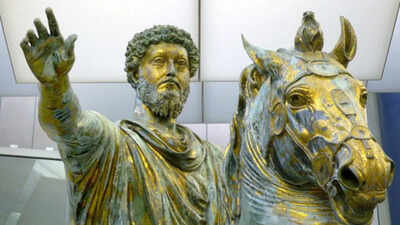
“The only wealth you will keep forever is the wealth you give away.”
A wealthy Romanian citizen walks through the crowded Sopora markets. His pockets are heavy with silver coins as he buys expensive silks, rare spices, and temporary loyalty to political allies.
Centuries later, the material wealth of that citizen turned to dust. His name was erased from history, and his possessions were scattered across the land. However, a few miles away within the imperial quarters, an emperor sits next to a flickering oil lamp, writing a very different philosophy of monarchy.“The only wealth you will keep forever is the wealth you give away.” He reads a saying that has long been associated with Roman thought. At first glance, this statement seems like a contradiction.
We’ve become accustomed to measuring wealth by what we accumulate: the balance in a bank account, the deed to a house, or the physical assets under our control. This quote completely flips that logic. It suggests that material possession is temporary, while the act of giving turns temporary resources into a permanent part of your personality and legacy.This principle changes our view of human value. He claims that hoarding resources creates a false sense of security, because death, theft, or political ruin can take away material goods at any moment.
On the other hand, generosity turns money into social bonds, memory, and moral character—assets that no one can confiscate.
Anatomy of imperial attribution
While modern books and digital citation sites often attribute this exact wording directly to the previous Roman EmperorMarcus Aurelius (161 to 180 AD) in his book “Reflections”But the historical reality is somewhat different. The Meditations were never intended for the public. It was a private journal written in Greek during the emperor’s absence on military campaigns between 170 and 180 AD.
In the actual text, Marcus expresses this idea through a more analytical philosophy rather than this specific poetic phrase.The exact wording actually matches a well-documented story about another famous Roman figure, Mark Antony, as recorded by the ancient biographer Plutarch. When Antonio faced financial ruin and the collapse of his political ambitions, he famously said that he had lost everything except what he had given up.
The Roman philosopher Seneca the Younger, who profoundly influenced Marcus Aurelius, also wrote about this precise concept.
Seneca said that the treasures we store bring bad luck, but the gifts we give to others are beyond the reach of fate.“I have everything I gave you.” – Mark Antony (from Plutarch’s “Life”)Whether spoken by Antony in defeat, orchestrated by Seneca, or lived by Marcus Aurelius, this idea formed the basis of Roman civic virtue.
The audience for these ideas was the Roman ruling class, men who were constantly tempted by the corrupting influence of absolute power and vast wealth. For an emperor like Marcus Aurelius, who ruled a region stretching from Britain to Syria, reminding himself that material riches do not last was a daily requirement for survival on earth.
Stoic accounting of the soul
To understand why this idea survived the collapse of the Roman Empire, we have to look at the psychology of Stoicism. The Stoics divided the world into things within our control (our actions, desires, and personalities) and things beyond our control (our bodies, reputations, and fortunes). Material possessions were viewed as “indifferent”. They were neither inherently good nor bad, and their value depended entirely on how a person used them.When a person hoards wealth, he associates peace of mind with external things that are inherently unstable. The philosophy behind this quote states that true ownership only occurs when you decide how to use a resource. By giving away wealth, you assert control over it. You prove that the object does not own you.Generosity functions as a tool that transfers value from the unpredictable outer world to the secure inner world of personal virtue.
Anthropologists see this same behavior across different cultures throughout history. In traditional ceremonies of indigenous peoples of the Pacific Northwest, status was achieved not by providing wealth, but by giving it away or sharing it during community feasts. The individual who gave the most money enjoyed the highest social status, and transformed material goods into lasting community relationships.
Redefining asset allocation
This ancient Roman framework relates directly to modern systems of philanthropy, business investments, and corporate leadership.
The current focus on building a legacy and creating social impact reflects the subtle shift from collection to distribution that Seneca supported.Think about how modern microfinance organizations work. When money is hoarded in traditional bank vaults, its use is limited to earning interest for a small group of people. When the same funds are distributed as microloans to women entrepreneurs in rural villages, the physical cash leaves the donor’s balance sheet but is transformed into local economic strength, education for the next generation, and community stability.
The donor’s wealth is no longer a flimsy pile of paper; You have become an active and positive force in the real world.In everyday life, this principle works at the psychological level proven by modern behavioral science. Michael Norton, a researcher at Harvard Business School, has shown through studies that people get more long-term happiness from spending money on others rather than on themselves. The pleasure of a personal purchase fades quickly through habit, while the memory of a meaningful gift or helping someone else retains its sentimental value for years.In the technology sector, a similar realization has changed the way founders view their innovations. Open source software movements, where developers give away their code to a global public for free, often create essential industries that outlast closed private systems. By abandoning technology, creators build a lasting digital infrastructure that carries their influence forward.Rome’s physical monuments have largely collapsed, and gold coins stamped with Marcus Aurelius’ face are now museum pieces. However, the philosophical record remains balanced. The wealth that was hoarded has been lost over time, while the ideas, structural laws, and social philosophy that these ancient thinkers introduced to the world remain active parts of modern civilization.