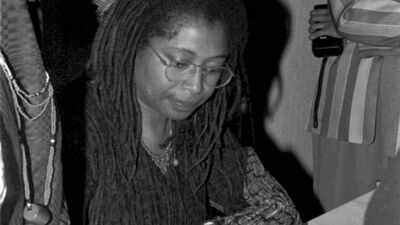
Alice Walker (Photo: Wikipedia)
How often do we decide we can’t do something before we try? We tell ourselves that we have no say, no influence, no real choice, so we stay quiet, stay put, and let things happen to us.
Writer and activist Alice Walker has put her finger on exactly this. She wrote that the most common way people give up their power is by thinking they don’t have any. It’s a sharp little observation that turns the usual story on its head. We tend to imagine that powerlessness is something that happens to us, a circumstance that we are simply stuck in. Walker points out that it is often something we do ourselves, quietly, just by believing it. Faith comes first.
Convince yourself that you don’t have power, and you will act exactly as if that were true, which is exactly how power escapes you.
Quote of the day Written by American social activist Alice Walker
“The most common way people give up their power is to believe they don’t have any.”
Who is Alice Walker?
Alice Walker is an American author and activist, born in 1944 in rural Georgia. She is best known for her 1982 novel The Color Purple, which won the Pulitzer Prize for Fiction and was later made into a popular film and stage musical. Thus, she became the first black woman to win a Pulitzer Prize in that category.
Across more than thirty books of fiction, poetry, and essays, Walker has written powerfully about race, gender, and the inner lives of women. She also spent a significant portion of her life involved in activism, from the Civil Rights Movement onward. This quote bears the hallmarks of that work, a lifelong interest in how ordinary people find or quietly surrender their power.
How we hand our power away
What makes the quote bite is the popular word. Walker is not describing a rare mistake.
It describes the usual way things happen. People rarely give up their power in one dramatic surrender. They give it up gradually, almost invisibly, by quietly assuming that they never had any to begin with.It’s an idea rooted in her years as an activist. One way people are discouraged is to convince them, slowly, that resistance is meaningless, and that nothing they do will ever matter. Once this belief is firmly established, no force is needed to keep it in place.
They keep themselves there. The other side is just right, and much more optimistic. The moment someone realizes that they have power, no matter how small, they begin to act differently, and things that once felt static begin to move.
Understand the meaning of the quote by Alice Walker
At its core, the quote is about the gap between real helplessness and perceived helplessness. They are not the same thing, even though we constantly confuse them. We often have much more power than we think, the ability to speak up, choose, reject, initiate, and shape the people and situations around us.The trap is that the feeling of nothingness becomes a kind of self-fulfilling prophecy. If you were sure that your vote or voice or effort changed nothing, you wouldn’t bother using them, and then of course nothing changes, which proves you’re right all along. Walker refers directly to that episode. The first and most important power you have is simply the ability to realize that you have some.
What is the significance of the quote from Alice Walker
This speaks to something that almost everyone feels at times. In the face of big problems or stubborn situations, it’s easy to shrink into a feeling of helplessness.
What difference can one person make? So we choose to withdraw, and this quiet withdrawal becomes part of the reason why nothing changes.None of this is to say that every situation can be fixed by attitude alone. Some restrictions are painfully real, and to pretend otherwise would be unfair to the people who face real walls. But Walker’s point still stands. Most of us routinely underestimate the power we actually have, and this underestimation costs us dearly.
Recognizing a small amount of power in your work, relationships, and community is often the first step to using it.
How to apply Alice Walker’s quote in everyday life
You can begin to reclaim your sense of power in small, practical ways.
- Catch “I can’t.” When you notice yourself assuming you don’t have an opinion on something, pause and ask if that’s really true, or just an all-consuming habit of thinking.
- Find the lever you have. You may not be able to control the entire situation, but there is always one thing within your reach. Start with that.
- Use your voice. Speaking up, asking, or simply saying no are all forms of power that people give up every day simply by remaining silent.
- Act small to feel it. Power grows through its use. A small, intentional action often does more to resolve a deficit than any amount of positive thinking.
Other famous quotes by Alice Walker
- “No one is your friend who demands silence from you, or denies your right to grow.”
- “Tough times call for angry dancing. Each one of us is the guide.”
- “Activity is the rent I pay for living on this planet.”
- “Some periods of our growth are so overwhelming that we don’t even realize that growth is what’s happening.”
There is quiet encouragement buried in Walker’s words. If powerlessness often begins as a belief, so does power. You don’t have to wait for permission or ideal conditions to arrive. Just stop assuming that you have nothing to offer. Notice the power you already have, no matter how modest it may seem, and use it. This simple refusal to exclude yourself is where almost everything else begins.