LAlo de Almeida is a documentary photographer based in São Paulo, Brazil. His photo essay in 2021 Pantanal burned Won first place in Environment Stories category in World Press Photo Contest. In 2022, he won the Eugene Smith Grant in Humanistic Photography and World Press Photo’s Long-Term Project Award for his work. Amazonian dystopiawhich documents the world’s largest tropical forest exploitation.
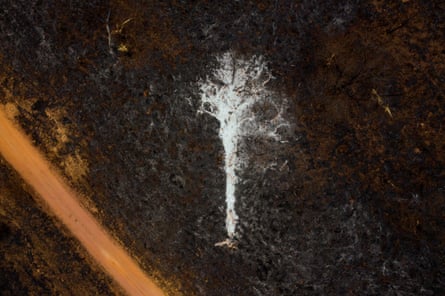
I have been photographing social-environmental issues for over 30 years, mainly in the Amazon. 2020 is no different. News of uncontrolled fires ravaging the Pantanal began to catch my attention. So, along with a fellow journalist, I decided to see what was happening for myself.
It was a shock when we reached this area. As the fire was brought under control, almost no fire was extinguished. I’ve seen a lot of fires in the Amazon, but nothing compared to this one. It is sad to see the number of animals killed in the fire. Wounded, burned and orphaned animals are even worse. 2020 is a tragedy. That same year, I returned three more times to monitor fires in the Pantanal. Since then, I have continued to photograph this area.
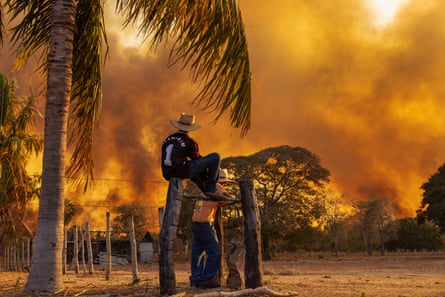
We are going to a farm in the Aquidouna countryside where firefighters and brigade members are battling a large fire. On the way, we started seeing several columns of smoke on the horizon. I stopped by Paraiso Farm to photograph a small fire. Within minutes, driven by the wind, the fire gained strength and speed, creating a column of smoke that stretched for miles. We had to leave quickly to avoid getting caught in the fire.
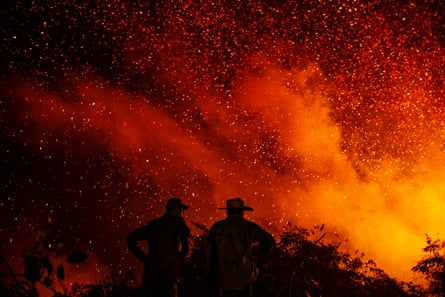
The unbearable heat, the burning vegetation, the choking smoke, all enveloped in an orange glow, was a sight I will never forget. Pure apocalypse.
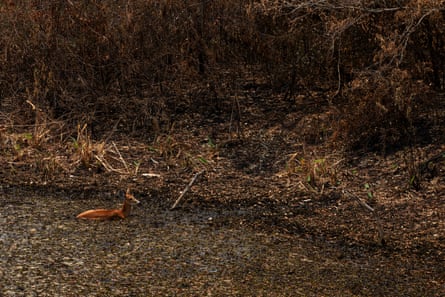
BR-262, the main road that passes through the southern part of the Pantanal, has seen several fires in 2020. Fires engulfed all sides, many animals took shelter in the water of small ponds by the roadside.
On the day this photo was taken, we saw dozens of marsh deer (Blastocerus dichotomous) in these small lagoons, an unimaginable sight in normal times. Usually shy around people, the deer seemed startled, unresponsive to our presence, having no other way to survive.
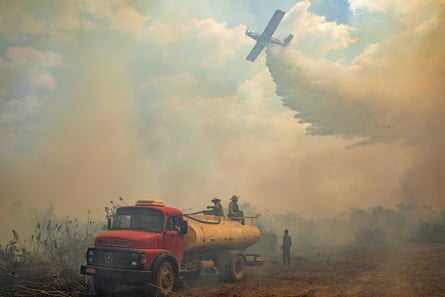
When we first arrived in the Pantanal to cover the 2020 fires, we were shocked. The hotel, which served as a base for firefighters and brigade members, was engulfed in flames and evacuated. Despite warnings of fire danger, there was no organized response, and Pantanal was left to fend for itself. There are thousands of fires scattered throughout the biome.
One day, while traveling on the Transpontaneira highway, I saw a lone fireman staring at a burning wooden bridge, unresponsive. He told me in a resigned tone: “There is nothing to be done here. The fires in the Pantanal will only end when it rains or when everything burns. Whichever comes first.” And he was right. The fire stopped only when it rained.
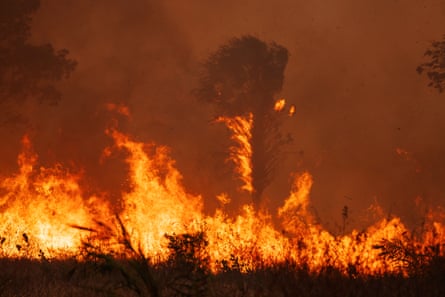
In August 2024, the Pantanal started raging again. My idea was to reach the place where the fire broke out in the Nekolandia area. About halfway there, we started seeing the first signs of fire. The drift smoke was thick as we drove along the sandy road, so we stopped at the retreat at Paraiso Ranch for information and to see if we could go further. The tall brush around the house was burning slowly, but still at a safe distance.
Within minutes, however, the wind picked up and the fire spread in a thick wall of flames and smoke. An indraft created by the heat from the fire fed it further, blowing it forward through the woods, destroying everything in sight. Heat, smoke, orange-tinged air and the crackling of burning trees created this hellish environment. Seeing such fires up close is terrifying experience That night, laying my head on the pillow, I couldn’t stop thinking about that scene.
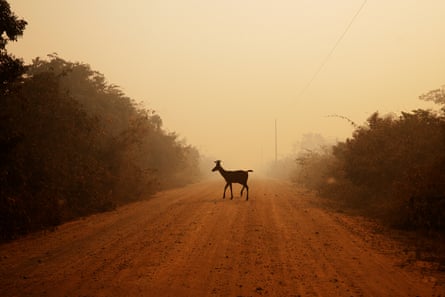
The Transpantaneira Highway is a park road north of the Pantanal, and probably one of the best spots. Brazil To spot wildlife. During the 2020 fires, it was common to find dead and carbonized animals on the roadside, especially alligators, snakes and turtles, which were too difficult to move around.
But the saddest and most wonderful thing is the survival. Injured or not, the animals looked like zombies, completely lost in the smoke. It is common to see alligators, moose, armadillos, monkeys, and deer roaming aimlessly along the road while fleeing a fire or searching for a water source amid severe drought.
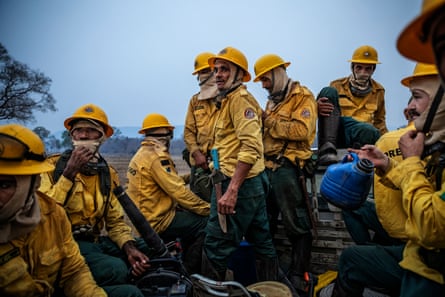
While photographing fires in an isolated area of the Serra do Amolar near Corumba, I had the opportunity to follow the work of the Privfogo fire brigade from Ibama, the federal environmental agency. They are the most qualified workforce to fight forest fires in Brazil. The team, consisting of farmers from Piayi state, traveled thousands of kilometers by car to fight the fires in the Pantanal.
The resilience and commitment of these men is impressive. They worked 12 hours a day, in the 40-degree sun, amid fire and smoke, risking their lives. In these conditions I could only photograph for a few hours, they spent the whole day there. They are anonymous leaders. Being with these firefighters and watching them work can only give me hope during the 2020 fires.
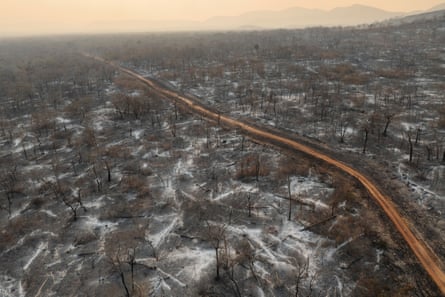
In 2024, I went back to Santa Teresa. I knew there were many fires burning on the ranch, but I didn’t know it would be 2020 again. The fire had just spread and, as before, I saw an enormous number of dead animals: tapir, monkeys, birds. I previously thought the 2020 fires were a freak accident.
But seeing it all again in person made me wonder if perhaps this is the new reality in the Pantanal. The new normal. The biome is very resilient, but these tragedies repeat themselves in short periods of time, often with severe wildfires fueled by water-loss and drought that have no time to recover.
Worse: Although people are now better prepared and more aware of what is happening in the Pantanal, nothing can control the fires. It was all gut wrenching to see up close; A reality check.
The reality of the Pantanal serves as a very instructive example of the effects of human actions on Earth. I want people who see my pictures not to see it as a distant thing happening on the other side of the world. We are all connected on this planet.
Water Pantanal Fire, featuring the work of Lalo de Almeida and Luciano Candisanion display at the Science Museum, London, 6 February – 31 May.