On January 28, Bangladesh Nationalist Party (BNP) and Jamaat-e-Islami supporters got into a row over front row seating at an event in Jenaigati upazila of Sherpur district, leading to violent clashes. At least 65 people were injured and the Jamaat Upazila The secretary was killed. Police and army personnel were present at the scene but could not stop the violence. Similar clashes have been reported across the country Bangladesh is heading towards national elections on February 12. The first since the dramatic ouster of former Prime Minister Sheikh Hasina in August 2024.

The 13th national election, involving nearly 127 million voters, has raised hopes of a peaceful transition from a post-Hasina interim government to elected rule. But pre-poll violence has posed new challenges to the electoral process. At least 15 political leaders and activists have been killed in the 36 days since the Election Commission announced the election schedule on December 11, 2025.

For first-time voters like Taimur Mobin, a 22-year-old graduate of Dhaka’s public university, the growing unrest has dampened expectations. “After a mass uprising that promised the restoration of voting rights, this kind of violence is deeply discouraging,” he said. “If this continues, many voters, especially the elderly, may avoid polling stations.”

Pictures of former Prime Minister Sheikh Hasina’s father Sheikh Mujibur Rahman are displayed at the Bangabandhu Gate in Gopalganj, Bangladesh on February 2, 2026. | Image Credit: Reuters
An alarming situation
Human rights organizations say the scale of the violence is alarming. According to the Human Rights Support Society (HRSS), at least 195 people have been killed and 11,229 injured in political violence in the last 17 months. Half of those incidents stemmed from internal conflicts within the BNP and its affiliates, resulting in 121 deaths and 7,131 injuries. Another rights group, Odhikar, reported an even higher number, saying 328 people were killed and 9,182 injured in political violence between August 9, 2024 and December 31, 2025.
Transparency International Bangladesh (TIB) warned that the risk of violence could extend beyond polling day. “We all hope that a murder or incident will not happen, but we cannot guarantee it,” said TIB Executive Director Iftekharuzhaman. “Based on past experience, the risk may persist for several days after February 12.”

TIB documents that between August 2024 and December 2025 at least 600 incidents of political violence were reported nationwide, resulting in 158 deaths. Mr. Iftekharuzzaman stressed that Bangladesh’s history of violent elections should serve as a warning. “Lessons from previous surveys should be used to prevent violence this time,” he said.
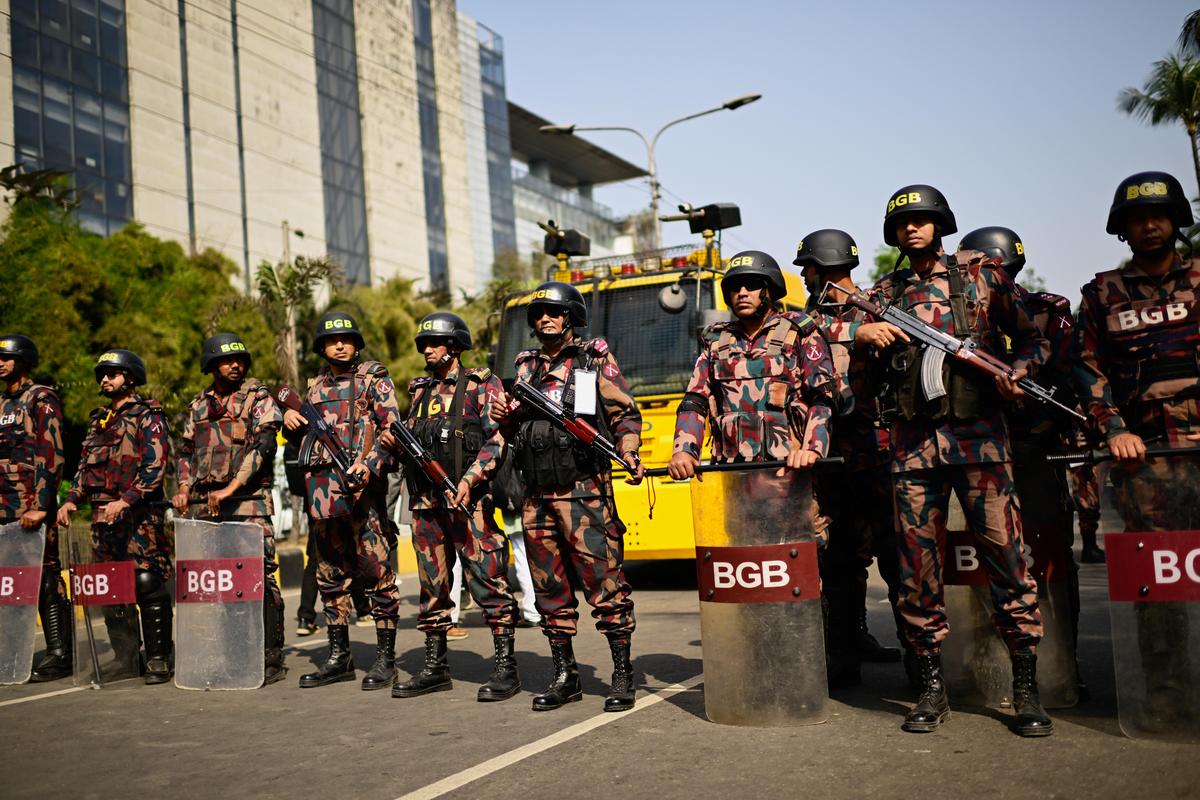
Bangladesh Border Guard personnel stand guard as Inquilab Mancha supporters hold a protest rally demanding justice for the killing of their party leader Sharif Osman Hadi in Dhaka, Bangladesh, Friday, February 6, 2026. Image Credit: AP
As polling day approaches, political parties continue to charge and counter-accuse. Jamaat-e-Islami has alleged repeated attacks on its women activists by BNP supporters and accused the EC of playing a “passive role”. Another Islamist party, Islami Andolan Bangladesh, claimed that its female preacher was attacked by Jamaat supporters. Independent candidates are not left out. On February 5, at least 20 people, including an independent candidate, were injured in an attack by BNP supporters in Chandpur-4 constituency. The BNP, in turn, accused the Jamaat of exploiting religious sentiment and harassing its women workers.
A vacuum of responsibility
Mr. Shahadat Shadin, a political analyst and research scholar at South Asia University, said the situation reflected the failure of the authorities. “Election-related violence is on the rise, but I don’t see enough seriousness from the interim government,” he said. “Election The commission is constitutionally mandated during elections, yet no visible action has been taken. This accountability vacuum is extremely alarming.”
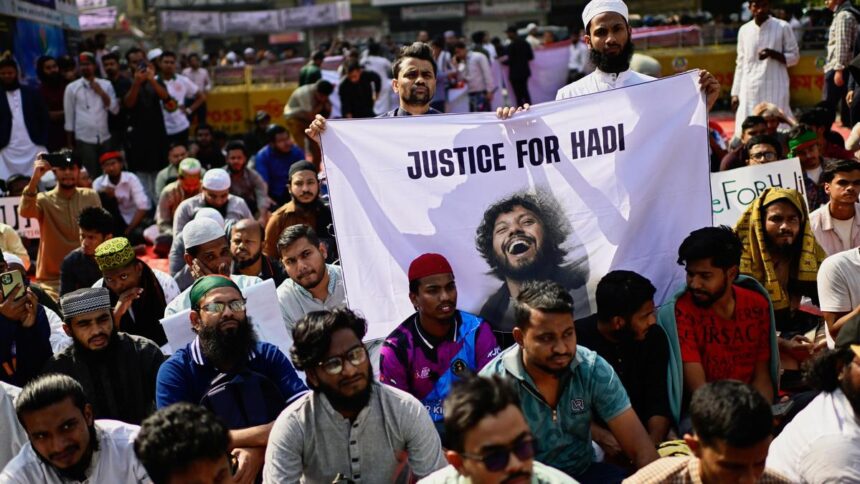
Adding to the volatility, Dhaka has been witnessing major protests unrelated to electoral politics. On Friday (February 6, 2026), government employees staged a dharna in front of the residence of Chief Adviser Muhammad Yunus, demanding implementation of the new pay scale. Police used batons, water cannons and sound grenades to disperse the protest, injuring dozens. Another forum, Inquilab Moncho, held demonstrations demanding a UN-supervised investigation into the killing of its spokesman Osman Hadi.
Meanwhile, the Bangladesh Army on Thursday (February 5, 2026) reiterated its full readiness to help conduct the elections and referendum in a “fair, free and peaceful” manner. Its director of military operations, Brig Gen Diwan Mohammad Monzoor Hossain, said the army was already conducting extensive field-level activities as part of comprehensive preparations.
Authorities are currently deploying a massive security apparatus, planning to send 900,000 personnel, including 100,000 military personnel, to polling stations from February 8-14. More than half of the country’s 42,761 polling stations are classified as “dangerous” and receive increased protection. Also, a total of 544 temporary army camps have been established out of 411 Upazilas In 62 districts of the country.