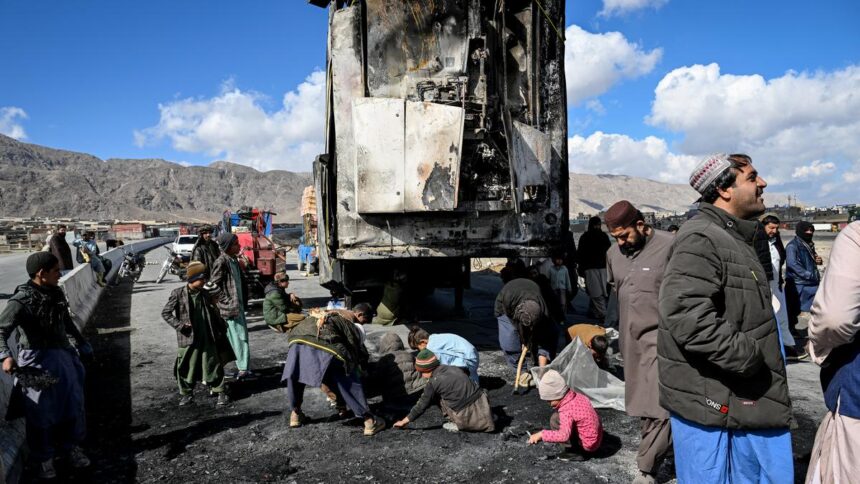

People gather as others gather recyclables next to a burnt vehicle along a road on the outskirts of Quetta on February 1, 2026, a day after an attack by Baloch separatists. | Image Credit: AFP
Pakistani security forces killed nearly two dozen militants overnight Several insurgency-prone attacks on Afghanistan’s southwestern borderofficials said on Monday (Feb 2, 2026) that the death toll from militants in the past 48 hours had risen to 177, following a wave of coordinated insurgent attacks that killed at least 33 people, mostly civilians.
Police backed by the army have been carrying out these attacks in several areas against members of the outlawed Baloch Liberation Army since early Saturday (January 31), when around 200 militants in small groups launched simultaneous suicide bombings and firing on police stations, civilian homes and security facilities across the province.
Analysts say the death toll from militants in the past 48 hours is the highest in decades.

The weekend attacks, which the BLA claimed killed at least 18 civilians and 15 members of the security forces, drew widespread condemnation from political leaders across Pakistan, including members of the party led by jailed former prime minister Imran Khan.
On Monday (February 2), Interior Minister Mohsin Naqvi praised security forces for killing an additional 22 insurgents in a statement. He described those killed as “Indian-backed terrorists”. However, he did not provide any evidence and there was no immediate response from New Delhi.

Despite being the largest province of Pakistan, Balochistan is sparsely populated, mostly composed of high mountains. It is also a hub for the country’s ethnic Baloch minority, whose members say they face discrimination and persecution from the central government. It fueled separatist insurgency demanding independence. Islamic militants are also operating in the province.
Train services between Balochistan and the rest of the country remained suspended for the third consecutive day, although officials said that normalcy had returned to the province on Monday (February 2). Provincial authorities suspended train services after the attack, citing security concerns, and the suspension remains in effect.

In March, at least 31 people were killed when BLA militants attacked the Zafar Express train carrying hundreds of people in Balochistan, taking passengers hostage before security forces could launch a rescue operation. All 33 attackers were killed and the passengers were freed.
The BLA, which is banned in Pakistan, has carried out several attacks in recent years targeting security forces, Chinese interests and infrastructure projects. Officials say the group operates with the support of the Pakistani Taliban, known as Tehreek-e-Taliban Pakistan, which is allied with Afghanistan’s Taliban rulers.
Published – February 02, 2026 05:22 pm IST