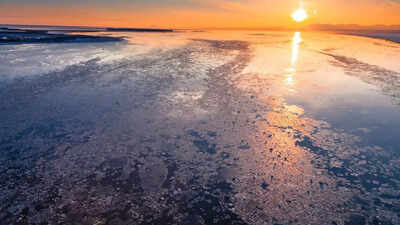
Most people expect nightfall to arrive at some point during the day. In one remote area of Alaska, this stops for weeks. Residents of the northernmost city of Utqiagvik in the United States have entered the annual “midnight sun” season, a strange period when the sun remains visible around the clock.
The city will not see proper sunsets again until early August, creating nearly three months of continuous daylight. To outsiders, it seems almost unreal. Bright skies at midnight, children playing outdoors in the late evening, and locals out for walks while the clock says it’s technically nighttime. However, for people living above the Arctic Circle, this unusual cycle has become part of everyday life, even if it still seems a little surreal every year when darkness disappears again.
Alaska midnight sun He returns to Utqiagvik for 84 consecutive days
The final sunset arrived long before daylight in Utqiagvik on May 10, as reported in an X (formerly Twitter) post by the National Weather Service in Fairbanks, Alaska. After briefly dipping below the horizon during the early hours of the morning, the sun has risen again and will remain visible until August 2.Utqiagvik, formerly known as Paro, is located along the Arctic Ocean about 320 miles north of the Arctic Circle.
Because of its extreme northern location, the city experiences one of the most dramatic diurnal transitions anywhere in America. During late spring and summer, the Earth’s tilt keeps the Northern Hemisphere tilted toward the sun, allowing places above the Arctic Circle to remain illuminated for long, uninterrupted periods.
Experts say that this phenomenon, commonly called the midnight sun, occurs in all regions of the Arctic to varying degrees.
In Utqiagvik, it lasts for 84 consecutive days.For many visitors, the first experience of seeing midnight sunlight is disorienting. The sky never gets dark. Time begins to feel strangely irrelevant.
Why doesn’t Alaska’s midnight sun bring true summer heat?
People often imagine that endless sunshine comes with hot summer temperatures. In northern Alaska, this assumption quickly collapsed.Even during July, which is usually the warmest month in Utqiagvik, daytime temperatures average only around 9°C.
Snowfall during the summer is not uncommon either. Last year, snowflakes were recorded on several days in June despite near-constant daylight. This contrast gives the city an unusual atmosphere. Bright sunlight reflects off icy roads and cold arctic waters while residents still wear heavy jackets outdoors.
It’s almost like winter trapped inside a summer day.Warmer periods arrive occasionally. Temperatures sometimes soared into the 20s during rare heat surges, although locals seem to treat those moments as short-lived bouts rather than normal summer weather.
The Arctic climate still dominates daily life, no matter how long the sun stays above our heads.
What it really feels like to have 84 days of daylight
The midnight sun affects more than just the sky. It changes the way people live. Many residents reportedly shift outdoor activities to the late evening hours because daylight remains strong throughout the night. Children continue to play outside after traditional bedtimes, while some locals go fishing, walking or cycling during hours that are usually very late elsewhere.Sleeping can become difficult for newcomers. Human body clocks rely heavily on darkness, and without it, many people struggle to know when the day should actually end. Blackout curtains are popular in homes around Utqiagvik for this reason.Even with preparation, the constant brightness still looks unusual. Some residents say the endless daylight creates extra energy and activity throughout the city. Others admit that it becomes exhausting after several weeks.
The experience seems to affect everyone differently.
What happens after Alaska’s endless daylight finally disappears?
Although the midnight sun may seem unusual, winter in Utqiagvik can be even harsher. Later in the year, the city will enter the polar night, the period when the sun does not rise above the horizon for 64 consecutive days. Instead of endless daylight, residents face weeks of darkness and dim twilight skies.This dramatic seasonal shift is one of the hallmarks of life in the Arctic.
People spend part of the year surrounded by constant brightness and part adapting to almost complete darkness. Visitors often find it difficult to imagine living at both ends in the same place. However, locals have adapted to the rhythm over generations. Schools, businesses and daily routines continue despite the unusual conditions outside.
From Fairbanks to Anchorage: Extended summer daylight in Alaska
Utqiagvik may get the most attention during the midnight sun season, although many other Alaska communities also experience unusually long days during the summer.
Fairbanks, located just south of the Arctic Circle, is said to see extended daylight for about 70 days. Anchorage experiences between 16 and 19 hours of sunlight during peak summer weeks, leaving only a short period of darkness throughout the night.Across the state, people tend to spend much more time outdoors once the longer daylight season arrives. Parks remain crowded until late in the evening, while restaurants and shops often remain active later than expected. However, the experience in Utqiagvik seems more intense than almost anywhere else in the country.For now, the city will continue to live under a sun that barely moves in the sky. No sunset, no real night. Just endless arctic daylight stretching across the horizon until August finally arrives.