


NASA’s upcoming Artemis II mission is the next crewed mission in the agency’s plan to explore deep space. The mission is the next step after the unmanned Artemis I mission.
The mission will be crewed and launched using a Space Launch System rocket and the Orion spacecraft, which will lift off from Kennedy Space Center in Florida.The mission will send astronauts to the far reaches of the moon and then back to Earth. The mission, using a Space Launch System rocket and the Orion spacecraft, will test the spacecraft’s navigation, life support, propulsion and communications systems, among other systems, while the spacecraft is crewed.
NASA Artemis II manned test flight and mission objectives
Artemis 2 is a manned test flight. It will send astronauts beyond low Earth orbit for the first time in the Artemis program. The mission focuses on system verification rather than exploration activities on the lunar surface.The spacecraft will follow a free return path around the Moon. This path allows Orion to orbit around the far side of the Moon and return without requiring major propulsion maneuvers.
It is a planned route used to support mission safety during early deep space missions.
Artemis II mission details: launch date, time and duration
The launch is scheduled for no later than April 1, 2026with a take-off target 6:24 PM EST. The duration of the task is expected It lasts for 10 days According to NASA reports. After launch, the rocket will place Orion into Earth orbit. The upper stage will then perform translunar injection to send the spacecraft toward the Moon.After flying by the Moon, Orion will begin its return journey and re-enter Earth’s atmosphere.
The mission will end with landing in the Pacific Ocean, followed by recovery operations.
Who are they? Crew members of Artemis II And their roles
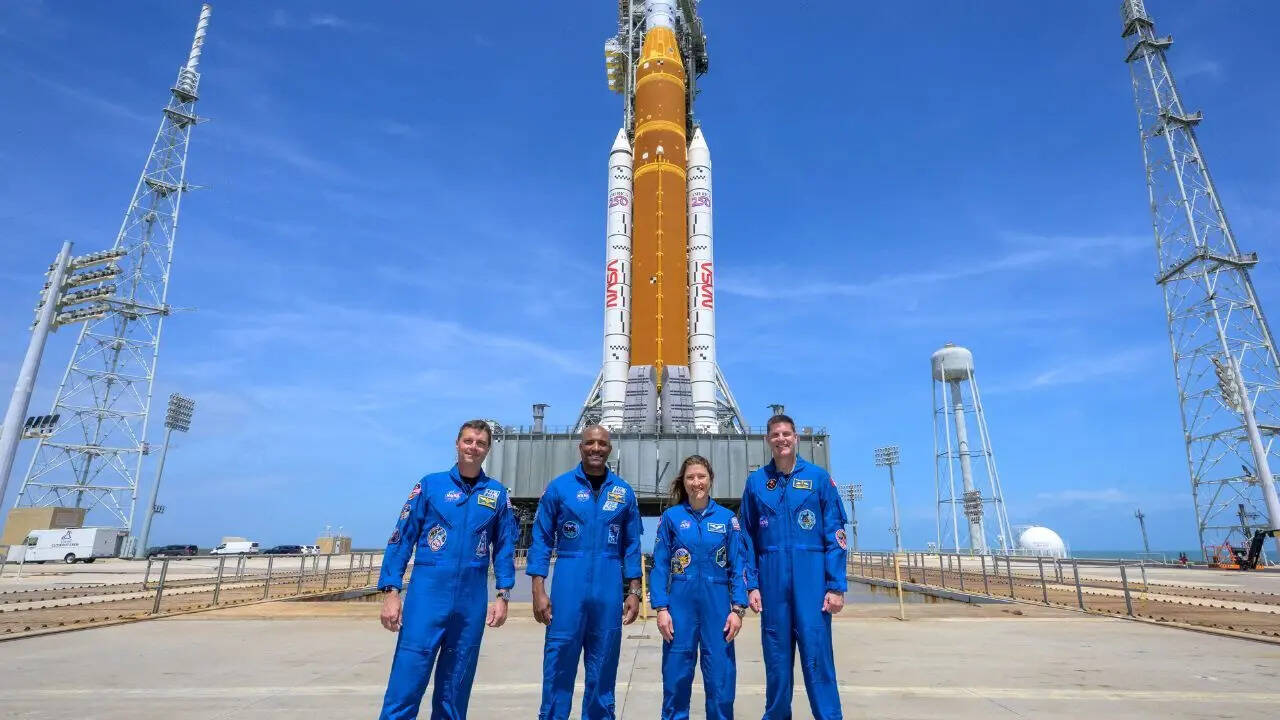
Computer: NASA
The Artemis 2 crew includes four astronauts:
- Reed Wiseman, Commander
- Victor Glover, pilot
- Christina Koch, mission specialist
- Jeremy Hansen, Mission Specialist (CSA)
Each crew member has defined operational roles. The leader leads the execution of the mission. Assists the pilot with spacecraft systems and navigation. Mission specialists support system monitoring, communications, and onboard procedures. Crew training includes simulations, emergency procedures, and spacecraft systems operations.
Their responsibilities span the launch, transit and return phases of the mission.
Artemis II launches today: How to watch live
Viewers can follow NASA’s official broadcast on both YouTube and NASA+, the agency’s free streaming platform. The YouTube broadcast begins Wednesday at 7:45 a.m. EST, covering tank operations and continuing throughout the entire 10-day mission. The NASA+ broadcast offers a shorter, structured briefing that begins at 12:50 PM EDT, focusing on key moments such as crew attire and ending after the deployment of Orion’s post-launch solar arrays.Watch here:
He watches
NASA’s Artemis II crew launches to the Moon (official broadcast)
NASA’s Artemis II program completed a 10-day schedule
| date | Time (EST) | Event details |
| Wednesday 1 April | 7:45 am | Coverage of tank operations begins with live views and commentary |
| 12:50 pm | NASA+ launch coverage begins; YouTube continues after the solar array is published | |
| ~2.5 hours after launch | Post-launch press conference (timing depends on take off) | |
| Thursday, April 2 | 8:30 pm | Mission briefing after translunar injection burn |
| 10:24 pm | Live downlink event | |
| Friday, April 3 | 3:30 pm | Mission status briefing |
| 8:44 pm | Live downlink event | |
| Saturday 4 April | 12:59 am | CSA live downlink event |
| 4:34 pm | Live downlink event | |
| 5:15 pm | Mission status briefing | |
| Sunday 5 April | 12:14 am | CSA live downlink event |
| 3:30 pm | Mission status briefing | |
| Monday 6 April | 12:45 pm | NASA+ begins lunar flyby coverage |
| 1:45 pm | The crew is expected to exceed the Apollo 13 distance record | |
| 10:39 pm | Live downlink event | |
| Tuesday 7 April | 2:29 pm | Crew communication with ISS astronauts (audio only) |
| 4:00 pm | Mission status briefing | |
| Wednesday 8 April | 3:30 pm | Mission status briefing |
| 7:09 pm | CSA live downlink event | |
| Thursday 9 April | 3:30 pm | Mission status briefing |
| 5:59 pm | Crew press conference | |
| 7:54 pm | Live downlink event | |
| Friday 10 April | 6:30 pm | NASA+ begins return coverage |
| 8:06 pm | Splashdown in the Pacific Ocean | |
| 10:35 pm | Press conference after the collapse |
Source: NASA
Artemis II: Design details of the Space Launch System rocket and Orion spacecraft
According to reports from NASA, the launch vehicle will be the Space Launch System, consisting of four RS-25 engines in the rocket’s core stage, along with two solid rocket boosters. The Orion spacecraft is designed to take astronauts to the Moon, which means it will go beyond Earth’s orbit. The Orion spacecraft contains the crew module, service module, and launch abort system.The launch abort system is designed to ensure separation of the crew module in the event of an emergency during launch.
Launch countdown and actions for Artemis II
Pre-launch operations begin several days before liftoff. Engineers perform system checks on various components of the rocket and spacecraft. These checks include diagnosing engines, avionics, batteries and communications systems.The Orion spacecraft’s flight batteries are fully charged. Batteries will be required during launch and early flight. The primary stage batteries are also charged. Batteries will be required during launch.
Engineers perform pressure checks on astronaut suits on the Orion spacecraft to ensure that the astronaut suits are working properly. As the countdown procedure approaches its final stage, non-essential personnel leave the launch pad area.
The ground launch sequencer starts up. The ground launch sequencer is an automated system that carries out the final countdown procedures. The system issues commands during countdown procedures, including engine ignition, valve operations, and system transitions.
Weather conditions for launch and its importance
Weather plays a major role in preparing for launch. Forecasts for the launch window indicate generally favorable conditions. Monitoring includes cloud cover, wind speeds, precipitation, and potential electrical activity. NASA is also working in collaboration with the US Space Force, specifically Space Launch Delta 45, to continually assess conditions. Weather restrictions include wind, cloud and lightning conditions.
Ground winds and upper level winds are also monitored to ensure vehicle stability. In addition, space weather is evaluated, including solar flares and charged particle activity, which can interfere with communications and navigation systems. As of NASA’s latest blog update on March 30, the weather forecast shows an 80% chance of favorable weather conditions, with cloud cover and the possibility of high winds hitting the ground as the primary weather concerns.Continuous real-time monitoring is conducted until liftoff, and any violation of weather parameters results in a delay to protect the crew and mission hardware.