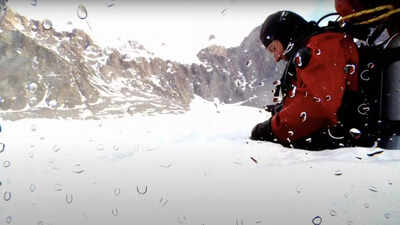
According to NASA, Lake Untersee is an underground body of water located in the snow-capped peaks of East Antarctica. It’s hidden like a time capsule, providing scientists with an essential resource to look back and study how life formed.
It has a very unique chemistry (i.e. pH = 10.4), and contains the highest amount of dissolved oxygen ever found in any freshwater ecosystem. The extreme, extraterrestrial conditions of this lake will allow scientists to better understand where life might exist beneath the Martian ice.Dale Andersen is SETI’s principal investigator and has made more than 20 trips to the site. It is reported that the cone-shaped “stromatolites” (microbial reefs that resemble the oldest known fossils on Earth) found at the site will be very useful in determining the location of life on Mars under the ice of the Red Planet.
How does Lake Untersee remain rich in oxygen under thick ice?
The most amazing feature of this lake is its enormous abundance of oxygen. Due to the permanent ice cover, gases such as oxygen and nitrogen are isolated in this system. For thousands of years, ice sublimates (turns directly into gas) at the surface, while new ice freezes at the bottom, pushing these gases into the water column. According to NASA, this results in 150% more oxygen than any regular lake on Earth.
Scientists believe this oxygen-filled environment provides a habitable habitat for strange microbial creatures living on Europa, one of Jupiter’s moons, where the same gas sequestration process may also be occurring.
What is the secret of “two meters high” in 2019?
In 2019, satellite measurements and ground sensors observed an unprecedented and rapid rise of 2 meters in the water surface in Lake Untersee over the course of just weeks.Scientists from the University of Ottawa describe how the surge occurred due to a glacial lake outburst flood (GLOF).
The flow of about 17.5 million cubic meters of water from Lake Obersee through a perforated ice dam caused the observed GLOF event. In addition, microbial peaks are a few centimeters long in most lakes in Antarctica; However, it is half a meter long in Lake Untersee due to its perfect stability, as discovered by SETI geobiologist Dale Andersen. Since there was no wave motion and no animals to disturb the bacteria due to it being permanent ice, the cyanobacteria were able to gradually grow on a limited amount of sunlight and build shapes unlike anything seen on Earth over 3 billion years ago.
Why Lake Untersee’s microbial peaks are ‘scientific gold’
The half-meter-high pinnacles at the bottom of the lake are shrouded in mystery, as they should not be able to survive in such a harsh environment. These are cone-shaped stromatolites composed of cyanobacteria. NASA’s Earth Observatory states that these organisms provide them with a horizon marker to identify living organisms.By studying the formation process of these peaks, scientists will be able to identify similar types of organisms on the frozen surfaces of Mars and in the ice crusts on Europa.