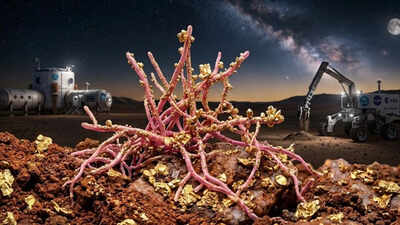
In the goldfields of Western Australia, researchers have discovered a strain of fungus known as Fusarium oxysporum that has a literal “Midas touch.” This organism has a pink color and is able to react with underground mineral deposits, breaking them down into a liquid state, and eventually forming solid golden crystals on thread-like threads.The presence of gold on the hyphae of this fungus allows for increased growth rates and sizes compared to cell cultures not infected with gold. The researchers now plan to further investigate the use of this biological chemistry to extract precious metals on the Moon and Mars. By using fungal biomining technology, future missions will be able to tap into a terrestrial biological wonder to provide the basis for infrastructure for extraterrestrial resource recovery.
A Fungi in Western Australia Who eats gold
Researchers from the CSIRO (Commonwealth Scientific and Industrial Research Organization) have discovered that Fusarium oxysporum is known to absorb gold from its surroundings through the process of dissolution and by depositing this gold as nanoparticles on hyphae (branching filaments). This process is highly reactive in nature and involves the production of superoxide by the fungi used to oxidize the gold, allowing the fungi to be coated with a layer of gold.
Why do mushrooms prefer gold?
The analysis, published in the journal Nature Communications, reveals that fungi coated with gold show greater growth rates than those not coated with gold, compared to fungi that do not interact with gold. This suggests that the presence of gold could serve as a catalyst for biochemical reactions or assist in the uptake of other nutrients, giving a competitive advantage to fungi in the mineral-rich environments of the Australian outback.
How microbes replace heavy machinery
Exploring minerals that process microbes, known as biomining, is a hot topic in studies by agencies such as NASA and the European Space Agency regarding potential implementation in space. Given the prohibitive cost of transporting large amounts of heavy equipment to the Moon or Mars, invisible to the naked eye, workers such as Fusarium oxysporum would likely be employed to extract gold and other minerals from regolith or soil on other planets.
The biological aspect of in situ resource utilization (ISRU) will support human presence in space over the long term in a more sustainable way.
How biological signatures could eliminate the need for expensive exploratory drilling
In addition to space use, this discovery has many direct applications on Earth as well. CSIRO scientists state that the presence of gold-plated fungi growing on the surface is an indicator to mining companies that gold deposits deep underground may exist in greater concentrations, and thus may eliminate the need for expensive drilling for exploratory purposes using biological indicators first.