Iran’s Islamic Revolutionary Guard Corps said on Wednesday that the Strait of Hormuz will remain closed “until the end of America’s evils,” but warned that other oil and gas export routes serving the United States and its allies may also be closed if the conflict escalates.This warning came at a time when the US military launched a new wave of strikes against Iranian military targets near the Strait of Hormuz and reimposed a naval blockade on ships passing to and from Iranian ports.According to Agence France-Presse, reported by Iranian state television, the Iranian Revolutionary Guard said that the Strait of Hormuz will remain closed “until the end of America’s evils.”
Trump is considering a “devastating” attack on Iran
Meanwhile, US President Donald Trump held a meeting in the Situation Room with senior national security officials to discuss a potentially devastating military attack against Iran, Axios reported, citing three sources familiar with the talks.
Discussions focused on expanding the scope of strikes beyond current operations near the Strait of Hormuz, as officials reviewed plans for attacks on strategic targets inside Iran.
Iran warns of a broader energy outage
The Iranian Revolutionary Guard also warned that if Washington tried to control regional sea routes, the consequences would extend far beyond Hormuz.“If Washington seeks to prevent oil and gas exports in the region by controlling sea routes, other export routes serve the United States
The Iranian Revolutionary Guard said in a statement that “interests and allies could also be closed.” The group added that regional energy exports will be “for everyone or no one.”The statement came after renewed US military operations in the region. Meanwhile, Iran’s Islamic Revolutionary Guard Corps claimed to have targeted US military facilities in Kuwait, according to Iranian state media.
US Central Command attacks Iranian facilities
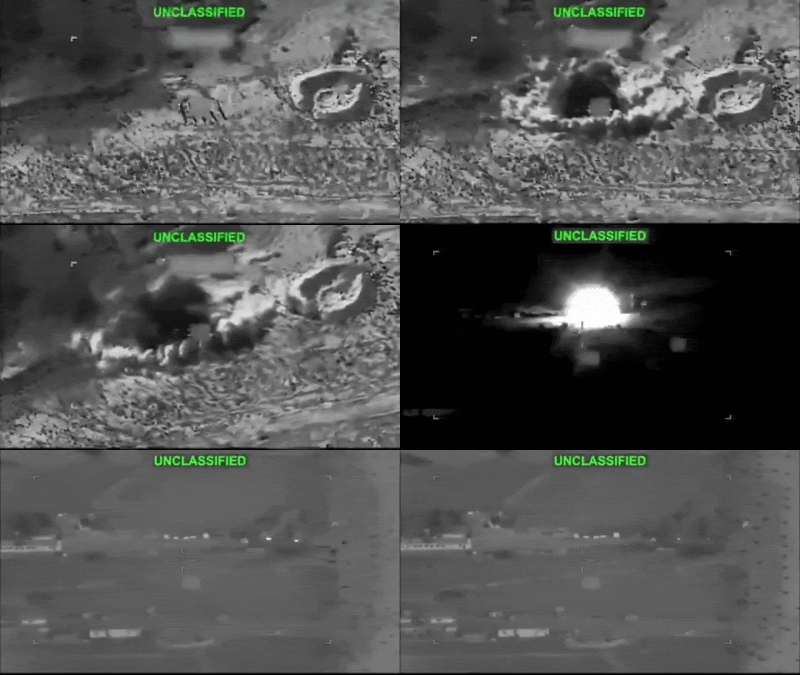
In a post on X, US Central Command (Centcom) said it had completed another round of strikes against Iran.“U.S. Central Command (CENTCOM) completed an additional round of strikes against Iran at 10 p.m. EDT, July 14, hitting dozens of military targets near the Strait of Hormuz and Iranian coastal areas.”Central Command said US fighter jets, drones and naval ships carried out a seven-hour operation targeting Iranian missile and drone sites, naval capabilities and coastal defense systems.
“U.S. combat aircraft, drones, and naval ships fired precision munitions against Iranian missile and drone sites, maritime capabilities, and coastal defense systems during the seven-hour wave to further impair Iran’s ability to threaten commercial shipping and civilian crews.”She added that the strikes coincided with the return of the US naval blockade. “The strikes occurred on the same day that US forces resumed a naval blockade against ships transiting to or from Iranian ports and coastal areas. The blockade went into effect at 4 p.m. ET today.”Central Command added, “American forces remain vigilant, lethal, and prepared to carry out operations directed by the Commander-in-Chief.”Earlier, US President Donald Trump announced the renewal of the blockade and warned of further military action unless Tehran returns to negotiations.In an interview with Fox News, Trump said: “I’ll save the energy goals for last, but in the end we will achieve the energy goals.”He added: “Next week the power stations will come, and next week the bridges will come, unless they come to the table and negotiate.”Trump also said that US officials conveyed a message directly to Tehran. “You better make a deal.”
and exacerbation of regional tensions
The latest escalation follows the collapse of a fragile truce reached in June after months of fighting between the United States and Iran.
Tehran said it closed the Strait of Hormuz again after renewed hostilities.The Iranian Revolutionary Guard also targeted US military facilities in Kuwait. Earlier, state media claimed that forces bombed what it described as command and control, logistics, fuel and military equipment facilities of the US Fifth Fleet in Bahrain.According to Iranian forces, the strikes came in response to what they described as American military actions against them and attempts to control the Strait of Hormuz and restrict shipping routes.Tehran also said that its army launched drone attacks on American sites at the Jordanian Azraq Air Base. The Jordanian army later said it shot down three missiles launched from Iran.Meanwhile, the Bahraini Interior Ministry said air raid sirens sounded across the country, urging residents to remain calm and seek shelter. The Kuwaiti Ministry of Defense said that its air defenses intercepted Iranian drones, while the official news agency reported that a fire had been brought under control.
Iranian Deputy Foreign Minister Kazem Gharibabadi rejected suggestions that increasing military pressure would force Tehran to return to the negotiating table.Gharibabadi told Iranian state television: “If the United States thinks that by tightening its measures against us, its military operations, and its economic blockade, we will return to negotiations, it is making a mistake.”According to the United States, Iran attacked seven commercial ships over the past week, killing, wounding or missing nearly a dozen crew members. On Tuesday, an Indian crew member was killed and eight others were injured after two UAE oil tankers were attacked by Iranian cruise missiles in the Strait of Hormuz.The Iranian Revolutionary Guard admitted that two “violating” giant tankers were hit after ignoring repeated warnings, but it did not identify the tankers.