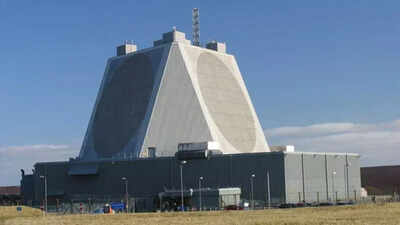
AN-FPS-132 Block 5 early warning radar in Qatar which Iran claimed was destroyed by
Radars are considered the “eyes” of war because they provide real-time, long-range situational awareness, allowing military forces to detect, track and identify threats emanating from competing forces.
Therefore, Iran targets all these “eyes” of the American forces in the Gulf region by launching drone or missile attacks on them. The Iranian Islamic Revolutionary Guard Corps said that its forces targeted radar systems in the UAE, Jordan and Qatar.
Iran’s missiles shake the Gulf: Explosions in the UAE, Qatar and Bahrain, and Saudi air defenses intercept the attacks
Since the conflict began in the last week of February, reports and satellite images show that Iran has either destroyed or severely damaged high-value U.S. radars and early warning systems installed in West Asia, including a $300 million AN/TPY-2 radar — used by U.S. high altitude area defense (THAAD) missile systems — in Jordan, a $1.1 billion AN/FPS-132 Block 5 early warning radar at Al Khor in Qatar, and the U.S. Air Combat Center and US Air Combat Center. Satellite communications in Al Khor. Al Dhafra Air Base in the UAE.
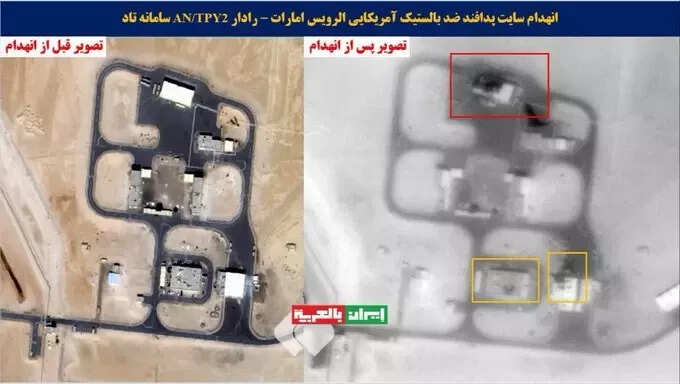
These strikes are likely to significantly weaken US missile defenses in the region. THAAD represents one of the most advanced missile defense technologies used by the US military. It is designed to intercept ballistic missiles in the final stage of their flight path high in the atmosphere, allowing them to neutralize long-range threats before they reach their targets.The target targeted by Iran was at the Muwaffaq Salti Air Base in Jordan, more than 500 miles from Iran.
The radar and THAAD battery appear to have been installed at Muwaffaq around mid-February, and were apparently struck on March 1 or 2. In another satellite image taken on March 1, smoke can be seen rising from a radar site near Prince Sultan Air Base in Saudi Arabia, where dozens of American aircraft are stationed. At the site, a tent used to house a radar system for a nearby THAAD battery burned. An AN/FPS-132 (Block 5) ballistic missile early warning radar system operated by the US Space Force in Qatar, which was also allegedly hit by a suicide drone, is the largest US-operated radar in West Asia, with a detection range of 5,000 km. The United States operates similar radar systems at only three locations on its territory, with additional systems deployed in the United Kingdom and Greenland. Iran also allegedly targeted satellite communications (SATCOM) stations at the US Navy’s 5th Fleet headquarters in Bahrain, along with two AN/GSC-52B stations and related buildings estimated to cost approximately $20 million. Reports indicate that in the first few days of the Iranian conflict, the United States lost about $2 billion worth of military equipment across the region.