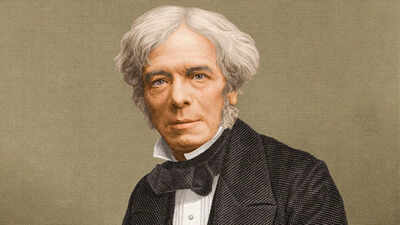
“There’s nothing quite as scary as someone who knows they’re right.”
A room full of smart people goes silent when someone speaks with complete confidence. Doubt creates space for discussion, compromise, and fact-checking. Absolute certainty does exactly the opposite.
He shuts down discussion, ignores warning signs, and treats any disagreement as a personal attack.“There is nothing quite as frightening as someone who knows he is right,“Warned the nineteenth century scientist Michael Faraday.Faraday’s observation gets directly to a fundamental truth about human nature. This quote reminds us that complete self-righteousness is much more dangerous than simple ignorance. A person who knows he does not have all the answers will stop to look at new clues.
A person who believes he possesses absolute truth does not feel the need to listen, verify facts, or back down.
The self-taught genius who questioned everything
This quote has its origins in a scientist who spent his life fighting easy assumptions. Michael Faraday was born in 1791 to a poor blacksmith in London, and received very little basic education. He learned the sciences while working as an apprentice bookbinder, reading the pages he was hired to sew together.Through hard work, he got a job as an assistant to chemist Humphry Davy at the Royal Institution.
Faraday went on to discover electromagnetic induction, invent the basic electric motor, and discover gasoline.Despite his enormous success in physics and chemistry, Faraday remained humble about human knowledge. He was a devoted member of the Sandemanian Church, a small Christian group that emphasizes humility and the limits of human wisdom. In his scientific talks during the 1840s and 1850s, Faraday often warned other researchers not to fall in love with their own ideas.While the exact words appear in letters, journals, and various accounts of his conversations, Faraday regularly shared this key point: The most dangerous mind in a laboratory is the one that has ceased to doubt itself.
The psychological trap of complete condemnation
Philosophers and psychologists have long studied why fixed certainty causes so much harm. In the 1990s, psychologists David Dunning and Justin Krueger published landmark research on human reasoning, showing that people with limited knowledge of a subject often overestimate their skills.
This phenomenon, known as the Dunning-Kruger effect, shows that trust often reaches its peak before true understanding begins.From a philosophical point of view, Faraday’s warning matches the ideas of Karl Popper, a twentieth-century thinker. Popper argued that true science depends on testing ideas to see if they can be proven wrong. A true scientific theory must always remain open to new facts.When a person loses the ability to accept that he may be wrong, he stops using reason and begins to follow blind belief.
History shows that when absolute certainty meets political, religious, or ideological authority, the results are usually terrible. Strict regulations, historic trials, and sudden financial collapses all depend on leaders who are completely convinced of their rightness.
Inexhaustible mindsets in everyday life
Today, Faraday’s warning applies far beyond scientific laboratories. Modern digital platforms are built on tools that reward anger and extreme viewpoints through thoughtful debate.
Online spaces often act as echo chambers, surrounding people with opinions that only confirm what they already believe.This creates leaders, managers, and public figures who refuse to change their minds when circumstances change. In business, the failures of major companies are usually due to their bosses being too sure of their plans, ignoring early warnings and feedback from their employees. In health care, government policy, and personal life, a complete refusal to acknowledge doubt halts learning and interrupts teamwork.In contrast, healthy teams rely on what contemporary workplace psychologists call psychological safety and intellectual humility. Groups perform much better when people can explicitly say “I don’t know” or “I was wrong.”
The virtue of staying open
Michael Faraday’s entire career was successful because he refused to believe that current science had found all the answers. When leading scientists thought that electricity and magnetism were completely separate, Faraday remained curious, conducted hundreds of failed experiments, and finally proved that they were connected.Shortly before his death in 1867, Faraday wrote a letter about his desire to keep his mind free from strict prejudice. He understood that knowledge is not a fixed wall, but an ongoing process of testing ideas against real world realities.Holding on to a healthy sense of doubt is not a sign of weakness. It is a necessary tool for survival, keeping people open to new facts, better ideas, and the simple fact that none of us know everything.