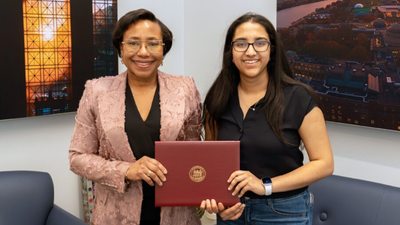
Avani Ahuja (right) receives her second Henry Ford Scholar Award.
Avani Ahuja, an MIT alumna of Indian origin, has received the prestigious Henry Ford II Scholar Award. This honor is among the Institute’s highest awards for undergraduate engineering students and celebrates academic excellence, leadership, and future promise.
During her time at MIT, Ahuja conducted research in power electronics, robotics, and women’s health technologies. She also received a prestigious Barry Goldwater Fellowship in 2025. This fall she will begin a PhD in power electronics at MIT with plans to explore applications in health care and women’s health research.
Avani Ahuja has received one of the highest engineering awards from MIT
The Henry Ford II Scholar Award is given to a senior undergraduate student who demonstrates exceptional academic achievement and strong leadership potential in engineering and the community.The award places Ahuja among a select group of MIT students recognized not only for their academic performance but also for their ability to make significant contributions to the engineering profession.Reflecting on the honor, Ahuja said, “I am extremely honored and thrilled to receive this award. It was an honor to meet Dean Hammond in particular.”
Research that helped obtain the award
Ahuja’s career has been marked by research in many engineering disciplines.
Her most recent work in the Coday research group has focused on capacitive wireless power transmission. This technology could eventually be used to wirelessly charge electric cars and power implantable medical devices.She also conducted robotics research under the supervision of Professor Sangbae Kim, whose lab is known for advanced bio-inspired legged robots.Ahuja described the research as one of the defining aspects of her experience at MIT.“My most significant experiences at MIT have involved engaging in research whether it be women’s health research under the supervision of Professor Kanan Dagdiveren, robotics research at the MIT Media Lab under the supervision of Professor Sangbae Kim, or power electronics research under the supervision of Professor Samantha Kodai.”Her ability to work across healthcare technologies, robotics, and electrical engineering has helped establish her as one of MIT’s most accomplished undergraduate researchers.
Her work is in women’s health technology
One of Ahuja’s strongest interests is women’s health research.She worked with Professor Canan Dagdeviren at the MIT Media Lab where she contributed to projects focusing on medical technologies for women.According to MIT, her research has included work on a wearable breast ultrasound patch designed to make breast cancer screening more accessible.This experience inspired her long-term goal of applying engineering innovations to healthcare challenges.“I hope to apply power electronics to women’s health research one day after I receive my doctorate,” she said.
She added the Goldwater Scholarship to her growing list of accomplishments
Prior to receiving the Henry Ford II Scholar Award, Ahuja was selected as a 2025 Barry Goldwater Scholar.The scholarship is considered one of the most prestigious undergraduate STEM awards in the United States. Only a few hundred students are selected nationwide each year.This honor highlighted her research achievements and her potential as a future engineer and researcher.
What’s next for Avani Ahuja?
Ahuja will continue her studies at MIT this fall as a doctoral student in power electronics within the Department of Electrical Engineering and Computer Science.Her future work will focus on power electronics while exploring opportunities to apply these technologies to healthcare and medical devices.She has also expressed interest in pursuing a long-term career in research and academia.
Life outside the laboratory
Besides her engineering studies, Ahuja has remained active in campus life through programs like MIT Ohms MIT LIVE and even dance classes.“I also really enjoyed participating in extracurricular opportunities on campus whether it was participating in the MIT Ohms program through MIT LIVE or dance classes in the Student Center,” she said.Ahuja also completed a minor in gender studies and credits professors Hafsa Aren and Marah Ghabar for broadening her perspective.“As a Gender Studies minor, I have to thank Professor Hafsa Areen and Professor Marah Ghabar for providing amazing WGS and CMS classes that have truly changed the way I think about the world around me.”
Mentors who shaped her journey
Ahuja credited her many mentors and faculty for supporting her throughout her time at MIT.She thanked Professor Samantha Coday, Professor Maria Yang, and Professor Kanan Dagdiveren, along with graduate students Colleen Marcus and Sarah Fernandez, and Associate Dean Kimberly Benard.“I also want to thank the entire Coday research group for being an amazing support system,” she said.As she prepares to begin her doctorate, Ahuja’s accomplishments already place her among MIT’s rising young engineers with research interests that include power electronics, robotics, and women’s health care innovation.