
A British minister has warned that the EU’s “Made in Europe” industrial strategy could damage supply chains, drive up costs and create unnecessary trade barriers between the UK and some members of the bloc.
UK Minister for EU Relations Nick Thomas-Symonds said European-made products should be prioritized in public procurement and consumer schemes as the EU prepares to publish new legislation.
The proposed law is designed to reduce dependence on foreign imports and boost local production in strategic sectors in an uncertain geopolitical environment.
“My concern is that if you have very strict priority requirements, you risk impacting our deeply integrated supply chains creating unnecessary barriers to trade in key UK-EU industries and driving up costs,” Thomas-Symonds told an economic event in Madrid. “This will obviously affect UK-Spain supply chains.”
Thomas-Symonds argues that Britain and the EU face similar challenges in raising competitiveness and productivity.
He said: “The UK is the fourth largest investor in Spain. We are not meeting those challenges by causing each other unnecessary economic damage.”
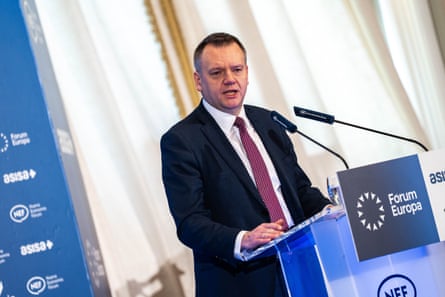
Thomas-Symonds’ intervention comes as Keir Starmer’s government looks to improve diplomatic and economic ties with the EU, Britain’s biggest trading partner, since announcing a “reset” deal last May.
In recent weeks, Starmer has hinted that the UK may seek sectoral deals deeper into the single market than those agreed with EU leaders in May, to be more efficient and consistent with EU regulation in other areas. Opposition parties are likely to face objections to such a move.
EU leaders agreed at a summit in Belgium earlier in February to push ahead with a “Buy European” policy aimed at securing the continent’s future amid geopolitical instability.
The 27 member states are looking to boost Europe’s competitiveness vis-à-vis the US and China at a time of economic uncertainty caused by the Trump administration’s tariff agenda and China’s export of heavily subsidized goods to the continent.
The draft “Made in Europe” plan includes member states of the EU as well as members of the European Economic Area – Iceland, Norway and Liechtenstein – but not Britain. However, the EU said it could include other “credible partners” in the future.
The “Buy European” program has long been promoted by France, but has drawn some criticism from member states including Italy and Germany — whose automakers have global manufacturing operations — who worry the rules are too narrow.
The European Commission is due to publish its Industrial Accelerator Act later this month, which is expected to set targets for European content in a range of strategic products such as solar panels and electric vehicles.