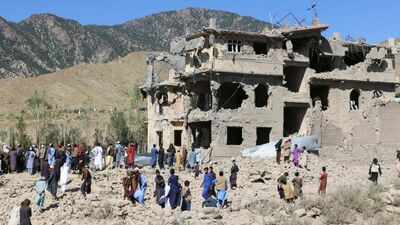
Effects of the strikes carried out by Pakistan in the Chamkani region of Afghanistan (Image source: Reuters)
Pakistani security forces carried out ground operations and air strikes along the Afghan border on Monday, killing 29 people, officials said. Pakistani Information Minister Attaullah Tarar announced the strikes onKabul presented a completely different narrative. Taliban spokesman Zabihullah Mujahid condemned the strikes as a “cowardly act of aggression.” Deputy Taliban spokesman Hamdullah Fatara detailed the civilian casualty toll in a social media post on Monday, saying: “According to reports available so far, the attacks carried out last night resulted in the martyrdom of 36 civilians, including women and children, while 163 others were injured.”
Three residential homes were completely destroyed.”
Fitrat provided a site-by-site breakdown. In Mandukhel village in Chamkani district, Paktia, Pakistani aircraft bombed a civilian residence, killing an elderly man and a child. He added, “After that, when local residents gathered to carry out rescue operations, the area was bombed for the second time, leading to the death of 28 villagers and the injury of 158 others.”
In the village of Walust in the Jayan district of Paktika province, six people were killed, most of them women and children.
A third strike on Barulu village in Manojai district of Kunar destroyed a house but caused no casualties.Pakistan denied targeting civilians.
What triggered the process?
The strikes came less than 24 hours after fighters armed with guns and explosives stormed the regional headquarters of the paramilitary Pakistan Rangers in Karachi on Saturday evening, killing three soldiers.
Security forces killed three attackers and arrested a fourth, whom the army said was a wounded Afghan citizen. The Al-Ahrar group claimed responsibility for the attack.Pakistan launched Operation Ghazb-e-Haqq in February, saying it aimed to eliminate cross-border militancy. But despite four months of air strikes, ground operations and claims of territorial progress inside Afghanistan, militants have continued to launch attacks deep into Pakistan, including Karachi.Monday’s operation was the second major Pakistani military action along the Afghan border this month. On June 10, Pakistani air strikes hit eastern Afghanistan. The Taliban said 13 civilians were killed, including 11 children. Pakistan said 26 Pakistani Taliban fighters were killed.On June 19, Afghanistan launched its own strikes inside Pakistan, targeting what Kabul described as ISIS-K camps and “enemy intelligence circles.”
Ground campaign
Operation Ghazb-e-Haq has included sustained airstrikes, artillery exchanges, drone operations and ground incursions across eastern and southern Afghanistan since its launch on February 26. Pakistani officials say their forces have killed more than 800 militants, destroyed more than 280 border posts, and struck more than 80 sites across Afghanistan. Kabul rejects these allegations, which have not been independently verified.The campaign took place across three broad fronts.In the north, Pakistani forces clashed with Taliban forces in Nuristan and Kunar, where prolonged bombardment closed roads to Kamdesh and Bargi Matal for nearly two months. According to the United Nations, the closures have deprived about 100,000 residents of food and medical supplies.In the east, Pakistani forces bombed Taliban corps, brigade headquarters, ammunition depots and border posts in Nangarhar, Khost and Paktia.
Satellite images reviewed by The New York Times and BBC News confirmed the raids on ammunition depots in Kabul and Kandahar. Pakistani aircraft also bombed Bagram Airport on March 1, destroying a hangar and two warehouses.In the south, the BBC reported in late March that Pakistan had fenced off about 32 square kilometers of Afghan territory in Paktika, with a fence line extending more than 12 kilometers into the border.
Afghan officials denied any occupation. Pakistan said the sites were tactical.The Taliban launched its retaliatory military operation on February 26, under the direction of Defense Minister Mullah Yaqoob, targeting Pakistani border sites in six provinces. Since then, it has launched regular cross-border drone attacks on Pakistani cities, including Islamabad, Kohat and Quetta. Most were intercepted, but the attacks were serious enough to force a ban on drone flights across Pakistan.
Ceasefire talks
Multiple ceasefire efforts have collapsed.A five-day Eid al-Fitr truce brokered by Saudi Arabia, Qatar and Turkey in March briefly held before fighting resumed. China hosted talks in Urumqi in April, but the Taliban’s deputy foreign minister said the discussions ended without an agreement and blamed Pakistani officials. This was followed by an informal tour of Termez, mediated by Uzbekistan, in early June.Pakistan’s three demands remain unchanged: Afghanistan must officially designate the Pakistani Taliban as a terrorist organization, dismantle its infrastructure and provide verifiable evidence of its movements. Kabul refused.Pakistani officials say operations will continue until these conditions are met. Pakistani Prime Minister Shehbaz Sharif said in May that the operation would continue with “full resolve.”
Should international mediators intervene to negotiate a ceasefire?
More than 3 thousand users shared their opinion today
More than 5 thousand users voted today
Share your opinion