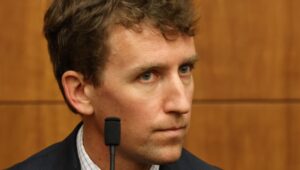
It was a “huge failure” for Joel Cauchi’s former psychiatrist not to recognize that he had relapsed leading up to the incident. Bondi Junction stabbing In 2024, a coroner found out.
The state coroner, Teresa O’Sullivan, handed down her findings in an 837-page report on Thursday after delaying the release following the December terror attack on Bondi Beach.
She recommended changes New South Wales Mental health system.
Family members of the victims gathered in court to hear the coroner’s findings in connection with the violent attack of 40-year-old Joel Cauchy at Westfield Shopping Centre.
CauchyAshley Good, 38, who lives with schizophrenia, Jade Young, 47, Yixuan Cheng, 27, Picria Darchia, 55, Dan Singleton, 25, and Faraz Tahir, 30, and shot dead 10 others. By Police Insp Amy Scott.
O’Sullivan confirmed that all six had died of stab wounds.
“While this inquiry will never change what happened, hopefully the recommendations will provide an opportunity for reform that could save future lives,” O’Sullivan said Thursday.
O’Sullivan says she refers to Cauchy Former psychiatrist, Andrea Boroughs-Lavackto the Queensland Ombudsman to look into her concern for him.
But O’Sullivan said it was “important to note” that her care was not the main factor that led Cauchy to murder six people. Dr Peggy Dwyer SC, senior counsel assisting the inquiry, said late last year: “No one could have imagined the tragic events of April 13. [2024] – It is not suggested that Dr. Boroughs-Lavack may have.
The coroner said Thursday that Boroughs-Lavack was exemplary and compassionate in caring for Kouchi from 2012 to 2019 and that she did the right thing in listening to his wishes to be weaned off his medication.
However, O’Sullivan found that Lavack “failed” to assess the severity of “what lay before her” when she returned.
“The care provided was one of many factors that led to this tragic outcome,” she said.
“While this inquiry will never change what happened, it is hoped that the recommendations will provide an opportunity for reform that could save future lives.”
She said the inquiry was an opportunity to examine Cauchy’s care, but also systemic problems in the state’s mental health system.
She recommended the NSW Government establish and support short- and long-term accommodation for people with mental health problems and homelessness.
The coroner recommended the NSW Government, over the next 12 months, seek advice on the decline of mental health outreach services and set a “realistic timeline” for resourcing such services.
Tragedy is ‘the end point of a long story’
Outside court, the families of the three victims spoke to the reports. Jade Young’s husband, Noel McLaughlin, said: “Jade was my wife, someone I shared life with for over two decades, and her absence leaves a vast and eternal void that cannot be carried alone.”
“Although the trial cannot undo our loss, it is important. It has helped us understand what happened and it has looked at these events with seriousness, care and respect.
“Evidence showed that what at first appeared to be a sudden and random act of violence was, in fact, the end point of a long story.”
Ashley Goode’s father also spoke briefly. He said: “If the shopping center systems were in place, the staff who worked there in the positions they had that day, they did their job successfully. My daughter would still be alive today.”
Three members of security guard Faraz Tahir, who lost his life on his first day on the job, also spoke. He remembered his bravery.
A major concern raised in the inquiry was whether early activation of shopping malls’ security alerts could have saved lives, especially the last of the Kouchi victims. O’Sullivallian found that was not a “realistic possibility” given the time it would take for Cauchi to complete his fatal attacks.
Kouchi was in a psychotic state and armed with a 30cm hunting knife when he went to Westfield Shopping Centre. Just three minutes later, Kouchi walked through three levels of the center and stabbed 16 people.
Kudos to Scott and the CCT staff.
O’Sullivan said the mall’s security firm, Scentre Group’s procedures, could only be described as “fantastic” to deal with an active armed crime event, despite some failures to enforce them on the day.
One of the CCTV control room operators, known as CR1 because of the suppression order on her identity, is competent and should not be left unattended, she said. She said it was not a personal criticism but a management one.
“[It was] A center group and a glad group who know she lacks the necessary skills O’Sullivan said it was a deliberate managerial decision.
O’Sullivan found problems with NSW police and the ambulance service working together and communicating when responding to an attack. In her summary she highlighted a recommendation for state emergency services to develop a framework to deal with this issue and draw on evidence from the trial.
Among the recommendations she highlighted was the NSW Government’s roll-out of a public awareness campaign about the active offender message of “Run, Hide, Tell”.
The inquest spent several days examining Cauchy’s interactions with police and mental health services before the attack. He had several interactions with the Queensland Police from 2021 to 2023.
A year before the tragedy in Bondi, the most notable interaction occurred when officers responded to a report he made that his father had stolen his knives. During a visit to his parents’ home in Toomba, where he lived at the time, his mother told police: “I don’t know how we’re going to treat him unless he does something serious.”
Officials emailed the officer in charge of mental health referrals at the area command, but he lost it. Among her findings, O’Sullivan did not criticize the officer for missing the email, saying he had a “significant workload”.
She said the Queensland Police Force had now implemented changes and would always act on such referrals.
Dava Chrysantou SC, who acted on behalf of some of the victims’ families, told the media outside court that the families would have more to say in the coming days after they had time to consider the report.
“Gaps, missed opportunities, and systemic failures were exposed across mental health, policing and the way we keep busy places safe. I want to recognize the courage of the first responders and members of the public who worked that day.”
“My hope now is that the findings and recommendations will be treated as practical obligations rather than abstract lessons.”