

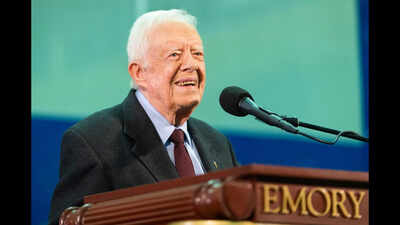
Former President Jimmy Carter won the Nobel Peace Prize in 2002.
One of former US President Jimmy Carter’s most memorable statements was about his faith as he wrote in his 1997 book Sources of Strength: Biblical Reflections for a Living Faith – “We must live our lives as if Christ were coming this afternoon.”
For decades, during his presidency and long after, Jimmy Carter taught Sunday school at Maranatha Baptist Church in his hometown of Plains, Georgia. In 1997, he compiled Bible lessons, personal prayers, and biblical reflections into a daily devotional book called Sources of Strength.The quote appears within a reflection on the Christian doctrine of the Second Coming and the idea of spiritual preparation.
Rather than treating Christ’s return as a distant, abstract event or getting bogged down in trying to predict a specific date, Carter said Christ’s return should be treated as an immediate, daily stimulus.Carter’s famous quote connects deep theology with practical, everyday work. It has transformed an abstract religious concept into an urgent call to do good now.When Carter was relatively unknown, he said the same thing in his classes.
He first used the phrase in March 1976 while addressing a Bible class at Maranatha Baptist Church in Plains, Georgia. At the time, Carter was a relatively unknown former governor of Georgia, running a difficult campaign for the presidency.
Jimmy Carter’s life, politics, and the Nobel Prize
Born in the small town of Plains, Georgia, in 1924, Carter grew up on his family’s rural farm, strongly influenced by the devout Baptist faith of his community. Graduated from the United States
The Naval Academy was established in 1946 and entered into the pioneering nuclear submarine program. However, when his father died in 1953, Carter made the difficult decision to resign his military commission and return to the plains to manage the family’s failing peanut farming business, turning it into a thriving enterprise.Carter entered politics in the 1960s as a state senator from Georgia and won the governorship of Georgia in 1970.
He gained national attention as part of a new wave of moderate Southern governors who publicly rejected the region’s long history of segregation, and actively worked to remove racial barriers and dismantle bureaucratic government waste.In the wake of the Watergate scandal—which left the American public extremely cynical of politicians—Carter launched a far-reaching bid for the presidency in 1976. Carter ran as an honest, deeply religious politician who promised “I will never lie to you,” and defeated incumbent Gerald Ford to become the 39th President of the United States.In 1980, he was defeated by Ronald Reagan. Carter viewed his electoral defeat as an opportunity for a new kind of service. In 1982, he and his wife, Rosalynn, founded the Carter Center in Atlanta. Through the center, Carter spent the next four decades serving as a global peacemaker, monitoring more than 100 free elections around the world and supporting global health initiatives. In particular, the Carter Center led a relentless international campaign that succeeded in bringing the horrific Guinea worm disease to the brink of global eradication.
In 2002, Carter won the Nobel Peace Prize. He died at the age of 100 in December 2024.