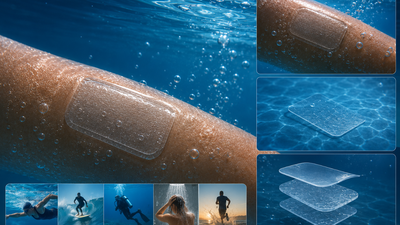
Imagine a material that can firmly adhere to wet surfaces, repair itself after damage, and remain flexible under challenging conditions. This vision has moved closer to reality thanks to researchers in Japan, who have developed a new super-adhesive hydrogel designed by artificial intelligence that has exceptional bonding strength underwater.
This breakthrough combines machine learning and laboratory experiments to identify the ideal chemical composition of a hydrogel that is remarkably highly adhesive and durable. In contrast to traditional trial-and-error methods, the researchers used artificial intelligence to speed up the discovery process, producing a material with record-breaking adhesion and impressive self-healing properties.
This innovation could pave the way for safer medical adhesives, soft robotic components, wearable electronics, and underwater repair technologies, demonstrating how artificial intelligence is changing the future of materials science.
How Japanese scientists used artificial intelligence to create a super-sticky hydrogel
Hydrogels are soft, water-rich polymer networks widely used in biomedical engineering, tissue repair, and drug delivery. However, designing a drug that is strong, highly adhesive, flexible, and capable of self-repair has long been a challenge because improving one property often compromises another.
To overcome this problem, researchers from Osaka University and collaborating institutions combined machine learning, data mining, and high-throughput laboratory experiments to improve hydrogel formation.According to the study published in Nature “New data-driven design of superadhesive hydrogels”:“We have created an AI-based material discovery framework for multifunctional hydrogels.”Instead of manually testing thousands of chemical structures, the AI model analyzed large data sets to predict the molecular structures that would produce the best overall performance.
The researchers then assembled the predicted hydrogels and validated them experimentally, significantly reducing the time needed to discover the materials.The resulting material demonstrated exceptional underwater adhesion while maintaining excellent mechanical strength and flexibility.
How does the new hydrogel compare to traditional hydrogels?
| feature | Conventional hydrogels | New hydrogel designed with artificial intelligence |
| Design approach | Laboratory tests are trial and error | Material discovery with the help of artificial intelligence |
| Underwater adhesion | Moderate to weak | Exceptional (greater than 1 MPa) |
| Ability to self-heal | Often limited | Fast and repeatable |
| Mechanical strength | It can rupture under pressure | High hardness and durability |
| Flexibility | moderate | excellent |
| Development speed | time consuming | It has been greatly accelerated using artificial intelligence |
| Potential applications | Wound dressings, drug delivery | Medical adhesives, wearable electronics, soft robotics, and underwater repair |
Conventional hydrogels are widely appreciated for their flexibility, high water content, and biocompatibility, making them useful in applications such as wound dressings, drug delivery, and tissue engineering.
However, they often struggle to combine strong adhesion, durability and self-healing in one material, especially in wet conditions where many synthetic adhesives lose their effectiveness. The AI-engineered hydrogel developed by Japanese researchers overcomes these limitations by incorporating exceptional underwater adhesion, high mechanical strength, elasticity, and the ability to repair itself after damage.
Unlike traditional hydrogels, which are typically developed through lengthy trial-and-error experiments, this material was discovered using an artificial intelligence-based framework that quickly identified promising chemical combinations before validating them in the laboratory.
The result is a multifunctional hydrogel with an underwater adhesive strength exceeding 1 MPa, making it one of the strongest reported in its class and opening new possibilities for biomedical devices, soft robotics, wearable electronics, and underwater engineering.
Why is this self-healing hydrogel a breakthrough in medicine and robotics?
One of the study’s most notable achievements is the hydrogel’s ability to maintain extremely strong adhesion even in humid environments, conditions where many synthetic adhesives perform poorly.Researchers reported underwater adhesive strength exceeding 1 megapascal (MPa), among the highest values recorded for multifunctional hydrogels.Equally important is its ability to self-heal. When damaged, the hydrogel can restore its structure through reversible molecular interactions, extending its functional life without the need for replacement.These properties make the material particularly promising for:
- Surgical adhesives and wound sealing
- Tissue engineering
- Wearable health monitoring devices
- Flexible bioelectronics
- Soft robotic actuators
- Underwater sensors and repair systems
The combination of strong adhesion, flexibility, and durability addresses many long-standing challenges in biomaterials engineering.
Why could AI change the future of smart materials discovery?
Beyond the hydrogel itself, the study highlights a broader shift in how advanced materials are developed.Traditionally, the discovery of new polymers required years of experimental screening. By combining artificial intelligence with experimental validation, researchers can quickly identify promising candidates while reducing cost and laboratory workload.As the authors conclude:“This work demonstrates the power of combining artificial intelligence with experimental materials science.”This approach is expected to accelerate discoveries in multiple fields, including sustainable materials, energy storage, biomedical engineering, and advanced manufacturing.Rather than replacing scientists, AI acts as a powerful research partner, allowing researchers to explore vast areas of chemical design that would otherwise be impractical.The new hydrogel represents one of the clearest examples of how machine learning can move beyond data analysis to directly enable the creation of next-generation materials with properties that were previously difficult to achieve simultaneously.