

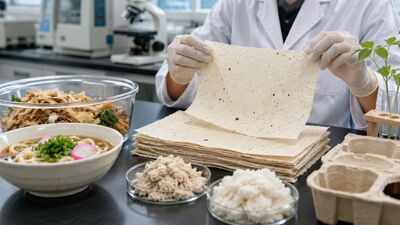
There’s something quietly regal about seeing yesterday’s lunch transformed into tomorrow’s stationery. In Japan’s Kagawa Prefecture, where thick plates of sanuki udon are part of the local identity, unwanted noodles are being given a second life that few expected.
Instead of being thrown away, surplus udon is turned into thin, biodegradable sheets with a texture reminiscent of traditional handmade paper. This process falls somewhere between microbiology, environmental science and local craftsmanship. They are small in scale, almost underestimated, but they nevertheless reflect a broader concern that many regions face: what to do with fully usable resources that lose value long before they lose their potential.
In Japan, it has been eliminated Udon noodles They find a second life like paper
Kagawa is closely related to udon. Restaurants specializing in wheat noodles are spread throughout the prefecture, and visitors often travel specifically to taste different varieties. However, the popularity of the dish creates its own difficulties. Once boiled, pasta does not stay at its best for very long. Prepared portions left over can lose texture and flavor, leaving stores with inventory that is difficult to sell.
For years, a large amount of this food has been thrown away. The waste was visible, frequent, and difficult to ignore. It was this local reality that prompted Professor Naotaka Tanaka of Kagawa University’s College of Agriculture to think differently about what pasta might become after its life as food ends.
The science behind Kagawa udon paper
The idea didn’t start with paper at all. Tanaka has long been studying microorganisms and bacteria capable of producing cellulose, a natural material that forms the structural basis of plant cell walls and is used in many types of paper.At some point, discarded pasta became part of this research. Their starch content was a source of sugar once broken down, creating an environment in which cellulose-producing bacteria could thrive. The concept seemed simple enough, though the result was unexpectedly elegant. The noodles are first mixed with water until they become a thick liquid. Enzymes are introduced to convert starch into glucose, creating nutrients for the bacteria.
Over several days, as the microorganisms grow, they gradually form a thin film of cellulose that floats to the surface.This membrane is then carefully removed and left to dry naturally. There is no traditional papermaking stage that involves wood pulp or heavy industrial machinery. The leaf appears simply through biological activity and time.
Amazing durability of udon-based paper
At first glance, the endpapers appear fragile. They are thin and light, and have some of the texture associated with Japanese washi paper.
However, appearances can be misleading.As Japan Today reported, the material resists tearing better than regular paper and handles moisture surprisingly well. However, once eliminated, they do not persist indefinitely. It is buried in the soil, gradually decomposes through the action of naturally occurring microorganisms, and returns to the environment without leaving behind persistent waste. One serving of udon can yield several sheets about the size of A4 paper.
It’s a modest return, though enough to support a growing range of uses.
Challenges of producing paper with living organisms
Reportedly, several years ago, the university shared the production method with a local social welfare organization free of charge. The process itself is relatively light and does not require heavy physical effort, making it suitable for workplaces that support people with disabilities. The transition was not entirely smooth.Initially, bacteria unrelated to the project contaminated the growing plates.
In other cases, mold spreads through the cellulose films before they dry properly. Producing biological material within an active workplace brought challenges that laboratory conditions had largely avoided.Ultimately, the temperature-controlled grow boxes helped stabilize production. The welfare organization now produces about a hundred papers each month, enough to support a small but effective system.
How restaurants, researchers, and staff share this process
The project has gradually formed a quiet network across the province.Restaurants serve pasta that would otherwise be thrown away. The welfare facility converts the material into cellulose sheets. The university purchases the finished products, which helps keep the course active while continuing research into new applications. Some of the papers have already appeared in promotional merchandise and artwork.
Fans, decorative pieces and handcrafted objects have proven that the material can be used in ways beyond scientific curiosity.Researchers are also examining other possibilities. Because leaves decompose naturally, there is interest in products designed to disappear after use, including artificial fishing lures and similar materials where biodegradability offers practical advantages.