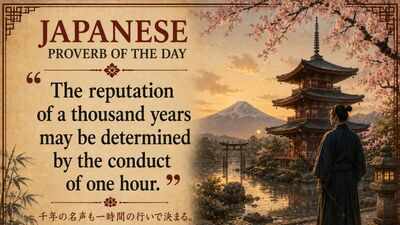
Japanese proverb of the day (image generated by artificial intelligence)
A thousand years for one hour. This is the strange arithmetic at the heart of this Japanese proverb, and it’s worth pausing over. He says that the reputation of a thousand years can be determined by the behavior of a single hour.
Sit with that for a second. The good name you spent your whole life building, and perhaps the name your family has built over generations, can be compromised by what you do in one bad moment. This statement serves as a warning and a reminder at the same time. Trust is much more delicate than what you feel while holding it. And the way you act when things get tough matters much more than all the calm that extends when nothing is being tested.
Japanese proverb today
“The reputation of a thousand years may be determined by the conduct of a single hour.”
The meaning of the proverb
There are two time periods opposite each other, and they couldn’t be more dissimilar.
A thousand years means everything is slow regarding reputation. You gain confidence in small pieces. You show up, keep your word, and behave appropriately when no one is watching the results, and over the years this assembles into something people depend on. None of this happens quickly.One o’clock is a different beast. It’s a short behavioral burst, usually under stress, when your true personality is pulled out into the open. Maybe you are tempted.
You might lose your temper. Maybe your nerves are betraying you. Whatever the test, the proverb makes an uncomfortable claim: that one hour can outweigh all those patient years.So the reputation turns out to be unbalanced. Slow to build, quick to demolish. One lie that comes to the surface, one ugly spectacle in public, one moment your courage deserts you, and that becomes the story people tell about you. The good years don’t disappear. They stop protecting you the way you always assumed they would.
Origins in Japanese culture
This line is often called a Japanese proverb, and it fits the ideas rooted in Japanese life. Honor is important there and so is self-control, along with careful attention to trust that keeps the family or workplace safe. When these things matter, your name isn’t quite your name. Part of it belongs to your family and circle, so you need to protect it for their sake as much as your own.It is difficult to determine exactly where the proverb began. Like many old sayings, it circulates in translation without a single tidy source to which you can refer in the original text.
What is in no doubt is how old the basic idea is, and how deeply people feel about it.In a culture that valued reputation and smooth interactions between people, you were expected to behave the same way whether or not anyone was watching, because everyone understood how a single shameful act could demolish a status that took generations to raise. This is the whole picture, captured in one photo. A thousand years of good reputation on one side of the scale.
One hour of behavior on the other.
The fragility of a good name
This proverb has survived because people keep seeing the same thing happen. A good name takes time to build and almost no time is wasted.A businessman spends thirty years becoming synonymous with honesty, signs a shady deal that leaks, and the thirty years are over. The politician serves calmly and well, then says something careless near the live microphone, and that’s the clip everyone replays.
A loyal friend earns your trust over decades, then throws it away one weak afternoon.Why does it continue this way? Because the shocking exception stays in our minds much better than the established rule. Years of simple decency never made the news. One fall does. This gap is what the proverb amounts to. The good we do slowly is taken for granted, while one serious misstep can fix the way we are perceived for good. Whatever you’ve built, it still needs to be protected the moment you put it to the test.
A warning to the modern age
If this warning was issued centuries ago, it is even more powerful now, because our worst moments are so easy to capture. One bad minute is captured and shared, then saved somewhere forever, ready to resurface years after you want to forget it. A reputation built over decades can take a hit when a single message is released in a moody mood.However, it’s not really about fame. It also works for trust between two friends, or for what your family quietly thinks of you. The lesson is not to live in fear. It’s to live awake. Few moments carry much more weight than others, and those are the moments we must face with a clear mind. Try to live so that your hardest hours, when they finally come, are the ones you don’t mind remembering.