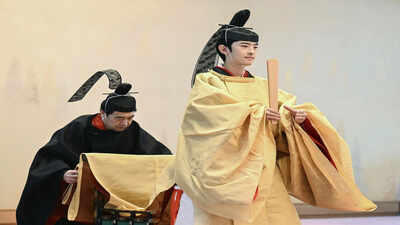
This issue has become increasingly urgent because the imperial family of Japan has very few male heirs.
Japan’s parliament on Friday approved changes to the country’s imperial succession law, introducing measures aimed at preserving the shrinking royal family but stopping short of allowing women to inherit the Chrysanthemum Throne despite strong public support for such a change.The legislation, passed by a large majority in the Senate, allows unmarried male descendants of former imperial branch families to be adopted back into the imperial family. It also allows female members of the Imperial Family to retain their royal status after marrying a commoner, a privilege that was already available to male members of the Royal Family.However, the amended law leaves unchanged the central provision of the 1947 Imperial Family Law, which allows only men of the male line to become emperor.This issue has become increasingly urgent because the imperial family of Japan has very few male heirs. The future of the monarchy currently rests with Prince Hisahito, Emperor Naruhito’s 19-year-old nephew and the only young man eligible to inherit the throne.If Prince Hisahito does not have a son, current succession rules would leave Japan without a future heir, raising concerns about the long-term survival of the imperial line.
The law also means that Princess Aiko, Emperor Naruhito’s 24-year-old daughter, and Prince Hisahito’s two older sisters are still barred from taking the throne despite their royal lineage.The legislation was approved after lengthy discussions within the ruling conservative party led by Prime Minister Sanae Takaishi, who opposed allowing women to succeed.Not everyone within the ruling camp supported this position.
Liberal Democratic Party leader Seiichiro Murakami criticized the restriction after the House of Representatives approved the bill on July 10, calling it “absolutely outrageous” that Princess Aiko would not be considered for the throne.The proposal to bring back distant male relatives has also drawn criticism from former members of the Japanese imperial family. Former King Asahiro Kuni, whose family left the imperial registry after World War II, questioned whether such a move was practical.“At 15, a person grows up breathing the air of freedom,” Kone told the Asahi Shimbun newspaper.“I think it will be difficult to adapt to life in the imperial family.”He added: “There may be people who want to join the imperial family, but if they understood the hardships of life as a royal member, they would probably not say such a thing.”The Japanese Imperial Family currently has 16 members, including only five men. They are retired Emperor Akihito, his younger brother, Emperor Naruhito, Naruhito’s younger brother, and Prince Hisahito.But public opinion seems to support reform. A poll conducted by the Asahi Shimbun newspaper in May showed that 72% of participants supported changing the law to allow women to take the throne.