When NASA Flight Director Zebulon Scoville was working a shift during the unmanned Artemis I test flight, he realized that the space agency was not live-streaming the spacecraft’s flight.
“They said, ‘Well, we don’t have the bandwidth, we have to collect all this engineering and composite data,’” Scoville recalls. “I was like—wrong.” “This program will end if people don’t buy it and don’t come with us.”
He watches
Watch: Unmissable moments from NASA’s Artemis II mission
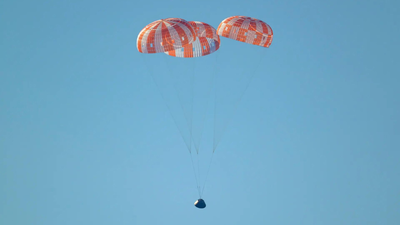
Scoville spent two years thinking about how best to attract audiences to NASA’s New Moon missions. This included adding an optical communications system to the Orion spacecraft, a laser that transmits to a ground station on Earth, sending a video feed at a higher resolution.Throughout the more than nine-day Artemis II crewed test flight — which ended Friday with an emotional crash off the coast of California — NASA maintained live programming on its streaming platform and across social media. This, along with third-party podcasts and streaming news, has garnered millions of views.Institutions including museums have held Artemis Splashdown parties. “I love having the live stream available to my students,” said Alex Roethler, a physics teacher at Wisconsin.
I also think it’s cool that they’re using Twitch, which is a favorite streaming site among gamers. The crew was integral to telling the story. During the nearly seven-hour lunar voyage, astronauts Christina Koch, Victor Glover, Jeremy Hansen, and Reed Wiseman gave near-literary descriptions of lunar surface features and left Houston awestruck. With Artemis 2, there were “just smiles and actually showing emotion across NASA, where sometimes we’ve had a history of being a little dry,” Scoville said.
He added: “It’s okay to jump up and down and howl at the moon.”