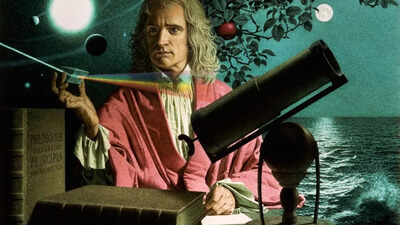
Isaac Newton is known as one of the most important scientists in history, yet so much of his personal life remains surprisingly unknown. He was known for gravity, laws of motion, and calculus, but there was much more to Newton than what textbooks tell us.
He had unusual habits, secret studies, and arduous work procedures. He was obsessed with alchemy, studied the Bible for hidden messages, investigated counterfeiters, and even tried to predict the end of the world. His childhood shaped his personality, his competition was intense, and his social life was limited. Here are 12 fascinating and little-known facts about Isaac Newton that explain the man behind the science.
Interesting facts about Isaac Newton About work, chemistry and personal life
Troubled childhood
Newton was born on Christmas Day 1642, but he was very small and weak. His father had already died, and when his mother married, she left him with his grandparents. His separation from his mother when he was a child seems to have affected him deeply. He grew up shy and isolated. As a teenager, he wrote angry thoughts toward his stepfather, showing early signs of his intense private nature. Even as an adult, he avoided social contact, never married, and spent most of his time alone in his studies.
Forced to farm
At about fifteen, Newton’s mother ordered him to leave school and work on the family farm. He did not enjoy it and struggled with the work. Eventually, the former school principal convinced his mother to let him return to school. Not long afterward, he went to Trinity College, Cambridge, leaving the farm behind him. This early rejection of agricultural life marked the beginning of the path that would lead to some of the most important scientific discoveries in history.
Apple story
In 1665, the University of Cambridge was temporarily closed due to the plague, and Newton returned to his home at Woolsthorpe Manor. One day, while he was sitting in the garden, he saw an apple falling from the tree. This simple observation eventually inspired his ideas about gravity. Newton told the story to William Stokely, who published it many years later in a book called Memoirs of the Life of Sir Isaac Newton, published in 1752. The apple tree still grows at Woolsthorpe, and in 2010, a piece of it was sent to the International Space Station as part of the Royal Society’s 350th anniversary celebrations.
Lectures that no one attended
Newton became professor of mathematics at Cambridge University in 1669. Despite the title, his lectures were often empty. Students rarely came, and sometimes no one came at all. Newton didn’t seem to mind. He preferred to spend his time researching, writing, and experimenting. Teaching was never his focus, and he seems to have been happier with numbers, ideas, and calculations than with explaining things to others.
Arrest the counterfeiters
In 1696, Newton was appointed director of the Royal Mint, and later became its president. This meant that he was responsible for English currency, including tracking down counterfeiters. He personally investigated suspects, sometimes going to the streets of London to find them. Some of the people he arrested were executed, and he even received death threats. This was a very different job from mathematics or physics, but Newton approached it with the same meticulous attention to detail that he applied to his scientific work.
Alchemy and secret codes
Newton spent many years studying chemistry. He wanted to discover the Philosopher’s Stone, a legendary substance that could turn metals into gold. He kept his research secret and wrote notes in code. He also analyzed biblical texts, looking for hidden messages about the universe. These studies remained private, and they show a side of Newton that was curious about the arcane as well as the scientific.
Short parliamentary service
Newton served as Member of Parliament for Cambridge from 1689 to 1690 and again from 1701 to 1702.
Records show he spoke very little. In fact, he reportedly said only one thing during his tenure: He asked for the window to be closed because it was cold. However, his time in London allowed him to meet influential people, including King William III and the philosopher John Locke.
Controversy Calculus
Newton had a long and bitter rivalry with German mathematician Gottfried Leibniz over who invented calculus first. Newton had created his version in the 1660s, but did not publish it immediately.
Leibniz published his own work in the 1670s. Newton accused Leibniz of plagiarism. As president of the Royal Society, Newton influenced the committee that gave him priority. However, Leibniz’s notation is the most widely used in mathematics today.
Knight’s world
In 1705, Newton was knighted by Queen Anne. By then, he had inherited property from his mother and published his major works, including Principles and Optics.
He died in 1727 and was buried in Westminster Abbey, along with other notable figures such as Charles Darwin and Charles Dickens. The knighthood was a symbol of recognition not only for science, but also for its contributions to British society.
Extreme work habits
Newton often worked 18 to 20 hours a day, sometimes forgetting to eat or sleep. He kept detailed notebooks of experiments and calculations, which reflect a meticulous and obsessive approach.
His intense work habits allowed him to develop ideas that revolutionized science, but also contributed to his reputation as a recluse and socially distant person.
breakdown
In 1693, Isaac Newton suffered a severe psychological crisis, often described as a nervous breakdown. He spent five sleepless nights and temporarily lost touch with reality, becoming convinced that friends such as John Locke and Samuel Pepys were conspiring against him, highlighting his extreme mental exhaustion and emotional vulnerability.
Predicting the end of the world
He spent a lot of time studying Bible prophecy, trying to understand the history in the book. Newton even tried to figure out how long the world might last, and decided that the end of the world would not come before at least the year 2060. This personal interest shows that Newton was interested in more than mathematics and physics alone.