

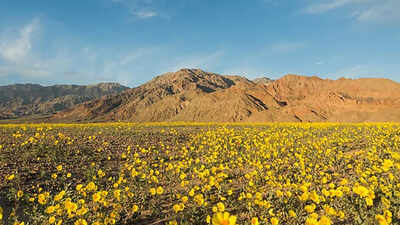
Source: National Park Service
Winter in Southern California has been unusually wet this year. Storm after storm rolled in, flooding cities and even the driest desert valleys. Now the humidity is starting to take its toll in a quieter, more colorful way.
Wildflowers appear across desert landscapes that often appear harsh and lifeless. Visitors heading toward Death Valley National Park already notice patches of yellow, purple, and orange spread across the sand.However, experts remain cautious. The bloom looks promising, even impressive in places, but many say it falls short of the dramatic level of a true “super bloom.” Timing, temperature, and wind patterns all play a role.
Rain alone does not tell the whole story. Right now, Southern California seems to have an above-average bloom that makes it special, even if it stops short of its desert history.
Death Valley shows promise as ‘super bloom’ conditions take shape in 2026
Even Death Valley, famous for being one of the hottest and driest places on Earth, recorded nearly double its usual rainfall for the season. This sounds like an excellent premium fuel. Experts say storm spacing matters more than initial totals.
Seeds need early moisture, consistent rain through the winter, and gentle spring warmth to survive. A sudden heat wave or strong winds can dry out fragile plants before they spread across the landscape.The word “superbloom” gets thrown around a lot. These events typically occur about once every decade and depend on a complex mix of factors, says ecologist Erica Newman of James Madison University. Precipitation is just one piece of a larger puzzle, but soil, air temperature and germination point to this.
She reportedly noted that strong winds alone can disrupt small plants, preventing flowers from spreading in the sweeping landscape associated with classic dazzling blooms.
Climate change adds another layer of uncertainty, changing seasonal patterns that plants have relied on for centuries.
Death Valley’s geography makes it ‘the hottest place on Earth’
Death Valley is a large structural basin located mainly in Inyo County in southeastern California. It is widely acknowledged to be the lowest, hottest, and driest region in North America.
The valley extends about 140 miles (225 km) from north to south, and varies in width from 5 to 15 miles (8 to 24 km). Mountain ranges make up the landscape, with the Panamint Range rising to the west, and the Black, Funeral, and Grape Mountains of the Amargosa Range forming its eastern border.
The valley is located near the shifting transition between the Great Basin and the Mojave Desert.The desert usually does not reveal its color that easily. In most years, sporadic flowers appear and then quickly fade.
This season looks different. Park officials, including updates from the National Park Service, say low-elevation areas are already thriving and may continue until mid- to late March. Roads like Badwater Road and Interstate 190 are said to offer some of the best early deals. Unpredictability is part of the magic.
Higher elevations may bloom later, extending into April and even June if conditions persist.
This erratic timing often leads to visitors returning, hoping to catch the desert at its peak.This winter’s precipitation totals appear unusually strong. Downtown Los Angeles has recorded well above average rainfall since October. Nearby Burbank recorded higher percentages than normal levels.
The 2016 desert landscape continues to influence bloom forecasts
Many observers still compare each bloom to the famous 2016 event in Death Valley. That year, it transformed vast swaths of desert into vibrant fields that could be seen from miles away.
Attendance rose as visitors rushed to see the rare spectacle.Interestingly, total rainfall prior to this bloom was not exceptionally high. The key appears to be well-timed early storms followed by favorable spring conditions. This year’s bloom may be stronger in isolated areas. However, the broad, landscape-scale coverage that defines brilliant blooms has not been fully achieved. Visitors are already sharing photos of poppies, desert gold, and tiny purple flowers pushing through the sandy soil.