

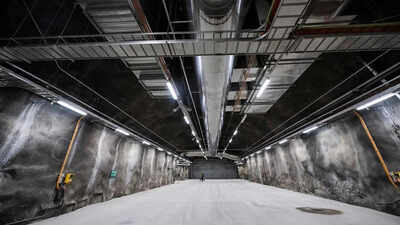
Deep in the pine forests of southwestern Finland, the rocks arrive first before anything else. They are ancient in a way that makes human construction seem temporary, shaped by geological time rather than anything built on the surface.
According to PBS, the underground facility known as the Onkalo Nuclear Repository is located near Yurajuki, where there is nothing above ground to really indicate what is happening hundreds of meters below. Deep down, the tunnels seem stripped of their bare essentials: humid air, rock walls, cables stretched over uneven surfaces, and the slow echo of movement. It is not a place designed for rest or spectacle. It is built on something far more definitive, which is the long-term handling of nuclear waste that cannot simply be forgotten or moved elsewhere.
How does Finland plan to trap nuclear waste inside ancient rocks?
The idea behind the site is said to be less about storage in the usual sense and more about gradual removal out of human reach. The spent fuel is first stored in corrosion-resistant copper canisters, then surrounded by bentonite clay, which expands when exposed to moisture. This arrangement aims to reduce movement, fill gaps, and limit any slow interaction with groundwater.Each canister is lowered into drilled holes cut into the tunnel floors.
Once filled, the sections are permanently sealed with reinforced seals, layer by layer. The tunnels themselves will eventually be closed one by one until there is nothing accessible of the surface infrastructure left. A capacity of about 6,500 tons of uranium fuel is planned, covering the output of Finland’s current reactor fleet.As reported by PBS, “We are now at a depth of 430 meters below zero (1,411 feet),” said geologist Thomas Beer as he drove a car through a maze of man-made tunnels. “We are walking through a bedrock that is 1.9 billion years old.”
A nuclear waste disposal project in Finland reaches the final regulatory stage
The project has taken decades to reach its current stage, moving through design changes, policy shifts and repeated safety reviews. The final regulatory assessment now falls to the Finnish Radiation and Nuclear Safety Authority, known as STUK, which is expected to complete its final assessment before granting an operating licence.The companies behind the site, including Posiva and utility operator Teollisuuden Voima Oyj, have described a cautious start to operations once approval is received.
Initial fuel transfers are expected to begin gradually, with material already stored in nearby facilities awaiting underground transport. Even at this point, there is no sense of completion. The system has been built, but it is not yet fully active, as if waiting for the point where engineering turns into routine burial work.
Nuclear safety design spans tens of thousands of years
As the study published in ScienceDirect, titled “Waiting for Waste: The Nuclear Imagination and the Politics of the Far Future in Finland,” stated, what sets Onkalo apart is the time frame around which it is built.
Safety models extend 100,000 years into the future, long after existing infrastructure, languages, and political systems have changed beyond recognition.Engineers focus on slow processes rather than sudden failures. Copper erosion, clay stability, groundwater flow, and the potential for seismic shifts during future ice ages are all part of the long-term assessments. No single factor is expected to cause failure on its own, but the interaction between them over wide time periods is treated with caution.According to a US Department of Energy YouTube video, the fuel will be safely stored more than 1,300 feet underground in corrosion-resistant canisters.
Public trust and quiet acceptance in Finland
In Finland, attitudes towards the warehouse have settled into a form of practical acceptance over time. There was early opposition, especially when the concept was first discussed decades ago, but it subsided as the project moved from theory to visual construction.Researchers have noted that trust in national regulatory agencies and long-term scientific evaluation played a role in this shift. There is also a legal requirement that nuclear waste produced in Finland remain within the country, removing the option of exporting the problem elsewhere. However, the anxiety has not completely disappeared. Environmental groups continue to claim that the safety of no engineering system can be guaranteed during these extended periods, as natural processes and human supervision inevitably diverge.