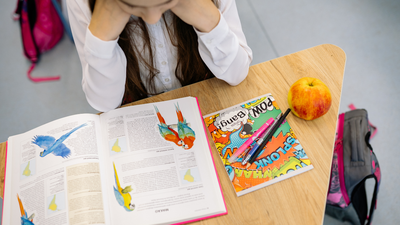
But then, in 2009, schools in Sweden took a bold step. They decided to replace books with laptops, tablets and digital learning tools. They have tried to create a modern learning platform with a touch of modernity and a sense of tech savvy.
It was a simple idea. They have tried to prepare children for the digital world with tools that are able to adapt quickly. They simply distributed tools instead of books. After that, schools were filled with smart gadgets. It was as if the future was already there.But then, in 2026, 15 years later, things changed completely. The Swedish government plans to invest £100 million in providing paper books to students in core subjects.
What prompted this radical change in school decisions in Sweden? What prompted this radical change in school decisions in Sweden? According to Schools Minister Lotta Edholm, “The best conditions for developing basic literacy skills are in analogue environments and the use of analogue tools.
Scientific studies have proven this to be true. Results from the Program for International Student Assessment (PISA) revealed that reading scores in Sweden fell sharply after the transition, reaching their lowest levels by 2012.
This isn’t just nostalgia. It’s a data-driven pivot to fixing what went wrong.
The digital education experience in Sweden: screens are blocked and textbooks are returned
Sweden went all-digital learning in 2009. There are no more books in classrooms. Computers and applications have replaced books, and students will enjoy learning in a multimedia way. The goal was to prepare students for success in the digital world and save money on book purchases. The beginning was good. Children had the world at their fingertips.But things took a turn for the worse. Children have become addicted to multitasking: studying, then browsing Facebook.
A meta-analysis showed how learning from books enhances comprehension more quickly than learning from a screen. The time middle school students spend in front of screens leaves them little time to practice handwriting and focus. Sweden’s standing in reading in Europe began to decline.
Low PISA scores and reading comprehension crisis
The implications were revealed through PISA tests. In 2000, Sweden excelled in reading; By 2012, their results had fallen to levels lower than those in the UK, with a drop of 10 points in reading and 15 points in mathematics between 2018 and 2022.
A quarter of secondary school students have become functionally illiterate, a factor in their over-reliance on technology.Minister Edholm did not mince her words: “We recognized that screen saturation had eroded focus.” This was also found through research conducted by the Swedish National Agency for Education, that screens led to poor vocabulary and distraction. Stocks were also hit, as not all homes had good internet connectivity.The trends were a reality check: technology cannot provide a solid foundation.
Increase government funding for physical textbooks
Enter reflection. From 2023 to 2025, Sweden spent SEK 685 million (Rs 6,853.31) in 2023, SEK 658 million (Rs 6,583.18) in 2024, and SEK 755 million in 2025 on textbooks and guides, for a total of £100 million spent in total. the goal? A book for every student for every subject, and libraries staffed by librarians. Laws now mandate accessibility, and inspectors monitor schools to ensure compliance. This is not against technology. Technology is still encouraged in projects, but in the early years, the focus was on pen, paper, and printing. Third-year national exams are still in analogue format, and in preschool, screens are banned for children under two. “Paper books are important for student learning,” Edholm said. Research conducted at the Psychiatric Unit, Fondazione Policlinico Universitario AgostinoGemelli IRCCS, 00168 Rome, Italy, confirms that handwriting is beneficial for memory, and typing is beneficial for deep reading.
reconnaissance
Do you think the return to paper books in Swedish schools is a positive change?
Lessons from Sweden Textbooks versus screens debate
Sweden’s story tells of the danger of digital overload. The screen dazzles, but it distracts. On the other hand, the book lays the foundation for the skill. It raises discussion all over the world: the balance between technology and tradition. The message for parents and teachers everywhere? Use technology well, but not exclusively. As Sweden resumes learning through the printed page, it may be able to lead again, both in terms of concentration and literacy.