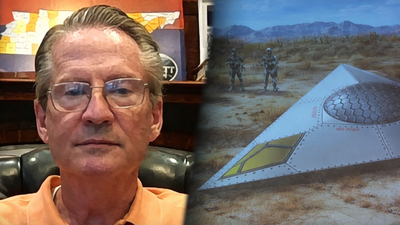
During a recent appearance on Newsmax, Rep. Tim Burchett said secret UFO mysteries could keep Americans “awake at night” and “the country unglued”/Photo: Youtube NewsMax
A congressman claimed that classified briefings on unidentified aerial phenomena contained information so disturbing that if made public it would fundamentally undermine public confidence.
These statements, made in a televised interview, add to a growing group of political voices demanding more transparency about what the US government knows, and raise new questions about why this information is withheld.
What Tim Burchett said, and didn’t do
Tim Burchett, a Republican lawmaker and member of the House Federal Secrets Declassification Task Force, said this week that federal agencies have briefed him extensively on matters related to UFOs and extraterrestrial activity.Speaking to Newsmax, Burchett did not reveal any details, but described the content of those briefings in stark terms. He said he had been “briefed by almost every alphabet agency out there,” adding that if the material were made public, “you’d be up at night, worried and thinking about this stuff.”He went so far as to say that a recent briefing he received “would have set the Earth on fire, and this country would have fallen apart, I think, if they had heard everything I heard,” and that such a release would prompt immediate public demand for answers.
Despite his repeated calls for “full disclosure,” Burchett made clear that he would not be the one to reveal what he knew. In the same interview, he noted that there may be consequences for those who speak out, saying: “For the record, I am not suicidal.”
Claims of confidentiality, hints of risk
Burchett also pointed to what he described as a pattern of unexplained incidents involving individuals associated with sensitive research. While he acknowledged that he had no specific explanations, he said that “there are no coincidences in this city,” pointing to reports of scientists and officials who “disappeared or died under mysterious circumstances.”“These people have disappeared or died under mysterious circumstances, and the only thing that links them together is the fact that they worked on things related to outer space,” he said, adding: “In general, I think there is a connection there. I don’t think we will ever know that.”
He watches
‘I’m not suicidal’: Burchett can’t find words to describe alien discoveries, discusses UFO files
These statements stop short of providing evidence, but they reflect a broader narrative, increasingly common in parts of American political discourse, that information about UFOs is being actively suppressed.Read also: Eight nuclear and space scientists behind America’s best-kept secrets have disappeared or died
The pressure is on for a reveal, and little has been released so far
Burchett said he personally urged Donald Trump to release government records, saying he asked him to “release them all.” Earlier this year, Trump indicated that he would direct federal agencies to begin the process of identifying and releasing files related to “extraterrestrial life, unidentified aerial phenomena (UAP), and unidentified flying objects (UFOs).”In a statement posted on social media, Trump wrote: “Based on the tremendous interest you have shown, I will direct the Secretary of War, and other relevant departments and agencies, to begin the process of identifying and releasing government files relating to alien and extraterrestrial life… and any and all other information associated with these very complex, but extremely interesting and important matters.”Despite this pledge, Shamil was not released.The Office of the Director of National Intelligence said the documents would be declassified “soon,” while the US Cybersecurity and Infrastructure Security Agency registered the domains “alien.gov” and “aliens.gov” in March. As of now, there is no active site. When asked about the ranges, White House Principal Deputy Press Secretary Anna Kelly told USA Today: “Stay tuned!”
Other voices, conflicting viewpoints
Burchett is not alone in raising questions about extraterrestrial life, although views within US leadership differ widely.For example, during a recent appearance on The Benny Show, J.D. Vance said he was “obsessed” with UFOs, though he admitted he “wasn’t able to spend enough time on it to understand it.” “We’re working on it,” he says, and that he will “get to the root of the UFO files,” noting that he still has “three more years as vice president.” He also offered his own explanation, saying: “I don’t think they’re aliens. I think they’re demons. They’re demons.”
“Read also: J.D. Vance classifies UFOs as “demons” and vows to reveal government secrets about unexplained phenomenaBarack Obama has described tackling this question head-on while in office, recalling that one of the first things he asked after becoming president was whether there was “a lab somewhere where we keep space samples and spacecraft,” and that officials “did a little digging and the answer was no.”“They’re real, but I haven’t seen them, and they’re not kept at Area 51,” he later said on a podcast with Brian Tyler Cohen.
This remark sparked criticism from Donald Trump, who said that Obama “provided classified information” and “made a big mistake.”Obama later explained that although the size of the universe makes it plausible that life exists elsewhere, “the chances of aliens visiting us are low,” adding that he had seen no evidence during his presidency that aliens had made contact with Earth.
Between suspicions and evidence
The renewed interest in UFOs comes amid years of changing terminology and policies.
What were once widely referred to as UFOs are now called “unidentified aerial phenomena” (UAP), reflecting the effort within government and scientific circles to treat such sightings as matters needing systematic investigation rather than speculation.In recent years, Congress has held hearings, commissioned reports, and pushed intelligence agencies to disclose more information. Some military footage of unprovoked air confrontations has been declassified, but these bulletins provide no definitive answers.