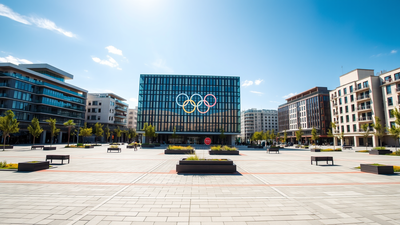
Each host city is building an Olympic Village, and almost every host city spends years deciding what to do with empty buildings once the athletes leave. Milan overcome this problem.
Architects at Skidmore, Owings & Merrill, working with Italian developer COIMA, designed the Milano Cortina 2026 Olympic Village on a 19th-century railway yard in the Porta Romana area, with its second life incorporated into the plan, and not subsequently added to. The complex opened to 1,300 athletes in February 2026, and by September 2026, the same six residential buildings are scheduled to reopen as the largest affordable student housing project in Italy, providing 1,700 beds for the academic year.
The transformation is expected to take four months from the closing ceremony to the students moving in.
Milan designed its Olympic Village as student housing from day one
What distinguishes the Porta Romana project is timing. According to the official announcement of the SOM project, the firm was selected to design the Olympic Village in 2021, years before the Games, with its post-Olympic role as student accommodation built into the brief from the beginning rather than added later. COIMA founder and CEO Manfredi Catella described this approach as creating spaces, functions and materials that are truly designed to ultimately transform them.
This early planning meant that the project never had to choose between serving athletes well and serving students well afterwards; Both uses of the same architecture were designed simultaneously, a sharp departure from the usual Olympic pattern of building first and worrying about reuse only once the closing ceremony had already concluded.
What SOM and COIMA have already built in the Porta Romana area of Milan
Located in a former 19th-century railway yard, the completed complex combines six new timber-framed apartment buildings with two restored historic buildings, including the former Squadra Rialzo locomotive workshop. According to the SOM project page, the project covers a total building area of approximately 53,380 square meters and includes 40,000 square meters of green space woven across the site. Colin Cobb, design partner at SOM, said the buildings were designed to draw on Milan’s historic architectural scale and materiality rather than directly mimic the older fabric of the city. Construction began in January 2023, and according to COIMA’s official press release, the buildings were delivered to the Fondazione Milano Cortina 2026 ahead of schedule.
How to transfer from the Olympic Village to student housing for four months
Because the conversion was incorporated into the design rather than modified afterwards, the conversion between Olympic use and student housing was unusually rapid. The village welcomed 1,300 athletes when the Games opened in February 2026, and according to SOM, the same buildings are scheduled to be permanently converted into Italy’s largest affordable student housing project by September 2026, in time for the new academic year.
About 30 percent of the approximately 1,700 units will be offered at subsidized rents, with the development already pre-qualifying for support under the Italian Ministry of Universities and Research’s financing decree that can reduce rents for residents for up to twelve years.
Why does Milan’s Olympic Village avoid the usual Olympic legacy problem?
Olympic infrastructure has a long history of being abandoned once the Games are over, from the empty venues remaining from the 2004 Athens Games to the underused Rio 2016 Olympic Park.
Milan’s approach treats the Games themselves as little more than a funding mechanism and deadline, rather than the true purpose of the building. COIMA’s Katila argued that the project sets a new standard for sustainability not only through its environmental performance but through what happens to it once the Games are over.
Likewise, SOM described the village as representing a new model for sustainable Olympic development, one designed to continue serving the surrounding community decades after the athletes are gone.
How the Olympic Village fits into the larger masterplan of Milan’s Porta Romana
The Olympic Village is just the first piece of a much larger redevelopment. According to COIMA, the project forms the opening phase of the wider Scalo di Porta Romana urban regeneration plan, which ultimately aims to deliver around 105,000 square meters of residential buildings across the area, with half of it designated as affordable housing alongside new commercial space and public parks. Once the conversion is complete, the Olympic Village Square is planned to become a neighborhood square lined with shops, bars, restaurants and cafes, while the surrounding park and adjacent railway buildings are converted into more affordable housing for the area as a whole.