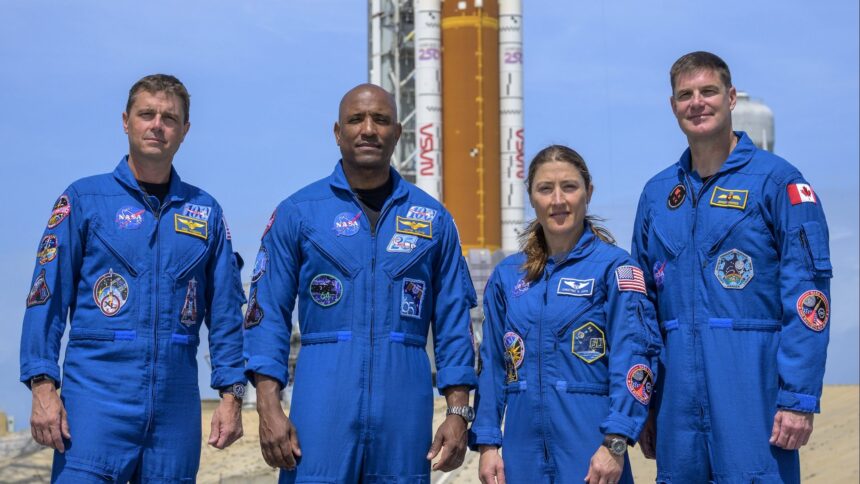

NASA is preparing to make history with… Artemis II missionas astronauts Reid Wiseman, Victor Glover, Christina Kochand Jeremy Hansen Heading towards the moon. The flight marks the first time humans have traveled beyond low-Earth orbit since NASA’s Apollo missions ended in 1972, marking a major step in the agency’s long-awaited return to deep space exploration.
This mission, part of NASA’s broader Artemis program, is designed to pave the way for future lunar landings and eventually human missions to Mars. Over the course of the flight, the four-person crew will test important systems aboard the Orion spacecraft as they travel around the Moon and return to Earth.
Here’s everything to know about the crew, timing, mission duration, and how to watch.
Who is in the crew of Artemis II?
The Artemis 2 crew includes four astronauts: Weissman, Glover, Koch, and Hansen.
As commander, Weissman brings previous experience on the International Space Station and his leadership as NASA’s former chief astronaut. Glover, a U.S. Navy captain and test pilot, serves as pilot and helps operate the spacecraft. Koch, a veteran astronaut who spent 328 days in space, is a mission specialist and the first woman to fly around the moon. Hansen, a Canadian astronaut, is also a mission specialist and the first Canadian to travel around the moon.
When was Artemis II’s release date?
Artemis II was launched on April 1, 2026.
Where was Artemis II released?
The mission lifted off from Launch Complex 39B at NASA’s Kennedy Space Center in Florida, the same historic site used for the Apollo missions.
How long will Artemis II stay in space?
The mission is expected to last about 10 days, during which the crew will orbit the moon and return to Earth without landing.
How can I watch live updates on Artemis II?
The Artemis II launch was broadcast live on NASA+, as well as on NASA’s official website, YouTube channel, and other streaming platforms and television networks covering the event.
Now that the crew is on their way, space fans can follow the mission on NASA’s website and social media.