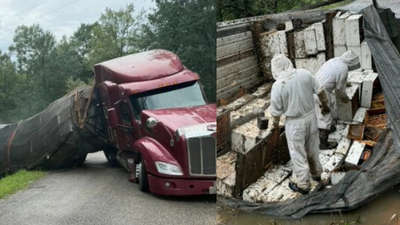
Residents of an Orange County, Texas, neighborhood were told to stay home after an 18-wheeler carrying hundreds of honey bee hives overturned, releasing millions of bees into the area.
The truck, which was transporting more than 400 hives for commercial pollination work, crashed after it took a wrong turn and attempted to turn a sharp corner. Emergency officials temporarily closed nearby roads and advised residents to keep windows and doors closed while beekeepers rushed to retrieve the colonies. Although no major injuries were reported, the incident led to widespread rescue efforts and raised concerns about the survival of thousands of bees.
How the 18-wheeler crash unleashed millions of honeybees
The accident occurred near Morrisville in Orange County, east of Houston. According to reports, the truck was transporting honeybees to North Dakota when the driver entered a residential area and lost control while navigating a tight turn.The trailer flipped into a ditch, causing hundreds of beehives to open. Within minutes, large numbers of bees escaped into the surrounding area, creating a potentially dangerous situation for residents and rescue crews.
Local emergency officials issued warnings urging people living nearby to stay indoors and avoid the crash site. Residents were advised to close windows and doors to reduce the risk of bee encounters.While honey bees are generally not aggressive unless threatened, millions of disturbed insects concentrated in one location can pose a danger, especially to people with allergies to bee stings.Roads surrounding the area were temporarily closed while emergency personnel and volunteer beekeepers worked to secure the scene.
Were there really 24 million honey bees?
The widely shared figure of 24 million bees comes from estimates based on the number of beehives on board the truck. Reports indicated that the vehicle was carrying more than 400 hives, with each colony containing approximately 60,000 bees.While officials have not confirmed the exact total number, beekeeping experts say the estimate is reasonable given the size of commercial colonies typically transported across the United States.
Why were so many bees moved?
Commercial beekeepers routinely move millions of bees across the country each year to support agriculture. Honey bees are essential pollinators for crops such as almonds, apples, raspberries and cucumbers.The bees involved in the Texas incident were reportedly transported for pollination work, a practice that has become an important part of modern agriculture. Large-scale pollination contracts often require transporting hundreds of beehives between states depending on the growing season.
Beekeepers raced to save colonies
One of the most notable aspects of the incident was the response of the local beekeeping community. Volunteer beekeepers quickly arrived on the scene to help restore the damaged hives and relocate the remaining colonies.Their efforts focused on identifying and protecting queen bees, which are vital to the survival of each colony. Without a live queen, the hive can struggle to recover and may eventually collapse.
Only a small portion of the hives may survive
Chris Moore, a local beekeeper who helped with the recovery, estimated that only about 25 percent of beehives might survive the accident.The survival rate will depend largely on the number of queen bees that survive the incident. Even if thousands of worker bees survive, the loss of a queen can severely weaken or destroy an entire colony.
No major injuries were reported
Despite the huge number of bees released, authorities did not report any serious injuries related to the incident. Some people at the scene were reportedly stung during recovery efforts, but no major medical emergencies were declared.Officials continued to monitor the area until the beekeepers were able to secure most of the remaining colonies and reduce the immediate risks to the population.
A reminder of the importance of honey bees
While the incident drew attention for its unusual range, it also highlighted the critical role honeybees play in agriculture. Millions of managed bees are transported across the United States each year to pollinate crops that help feed millions of people.For the beekeepers involved, the accident was more than just a traffic accident. Such was the potential loss of hundreds of colonies that support honey production and commercial pollination, making recovery efforts as important for agriculture as they are for public safety.