Imagine having a podcast at the time of the Apollo 11 mission in 1969, which was a pivotal moment in space exploration, and hearing what their first conversation sounded like. On July 20, Neil Armstrong, Buzz Aldrin, and Michael Collins achieved the impossible, landing humans on the moon for the first time.
This victory, in the midst of the Cold War space race, captivated the world and demonstrated American ingenuity. Perfect weather set the stage for liftoff from Kennedy Space Center in Florida, Neal, Aldrin and Collins said.
Kennedy’s words amid rising tensions
On that midsummer morning, conditions were fine. “The weather is very favorable, with 10-knot winds from the southeast, temperatures in the mid-80s, and clouds at 15,000 feet,” NASA noted in the Apollo 11 log, and crowds lined the Florida coast, their hearts pounding with anxiety.
However, inside the cramped cabin atop the towering 363-foot Saturn V rocket, the three astronauts remained calm. Their mission was an echo of the bold challenge faced by President John F. Kennedy nearly seven years earlier.According to a Rice University speech he gave in July 1962, “We have chosen to go to the moon in this decade and to do other things, not because they are easy, but because they are difficult, because this goal will serve to organize and measure the best of our energies and skills, because this challenge is one which we are willing to accept, and which we are unwilling to postpone, and which we intend to win, and of others as well.”
This deadline excited NASA, astronauts, and the public. As in the August issue of Spacesports, Michael Collins said later in 2014: “One was to set a deadline by the end of the decade, where you could motivate people… by saying, ‘We have to do this by the end of the decade.’” “It was a very powerful tool,” Collins credited NASA’s generous budget and talented team for the success.
Steady nerves with Saturn V rocket launch
A NASA flight surgeon reported that heart rates recorded thirty-six minutes after launch, Neil Armstrong at 110, Mike Collins at 99, and Buzz Aldrin at 88, barely higher than 60-100 beats per minute for a resting adult.
Calmness under pressure is what distinguishes these heroes.
First steps and words on the moon
Four days later, Armstrong and Aldrin piloted the lunar module Eagle toward the Moon, while Collins orbited it. The landing captured the attention of spectators around the world, especially as fuel dwindled. Armstrong took manual control, dodging the rock-strewn terrain to find a safe spot.NASA quotes Armstrong when Armstrong said over the radio at 20:17 UTC on July 20, 1969: “Houston, Tranquility Base is here.
“The eagle has landed.”Houston’s Charlie Duke responded: “We’re copying you down to Earth. There’s a bunch of guys about to turn blue. We’re breathing again.”Buzz soon joined him. “Beautiful view!” He shouted as he reached the wide landing pad. “Isn’t that something!” Armstrong agreed. “Great view here.”“Great devastation,” Aldrin said.Armstrong’s heart rate reached 150 beats per minute, the highest of any Apollo commander, yet he described the landing as “very gentle…
“It’s hard to know what time we were in.”
A small step on the moon, a leap for humanity
Six hours later, Armstrong came down the stairs. He took a quick sample of lunar soil as a backup, then ascended to the surface: “It’s one small step for man, one giant leap for humanity.”
Apollo 11 moonwalk montage
“It has a stark beauty of its own,” he added. “It’s like a lot of high desert in the United States. It’s different, but it’s so beautiful here.” After the mission, Armstrong shared the surprises: the near horizon and dust behavior with no atmosphere, no clouds, just sharp trails.Buzz Aldrin followed, carefully closing the door according to the checklist. “I watched out the window to see Neil coming down the stairs,” Aldrin recalls. “When it was my turn to back out, I remember the checklist said to step back carefully and close the door, being careful not to lock it.”
Moonwalking Achievements: Nixon’s Words
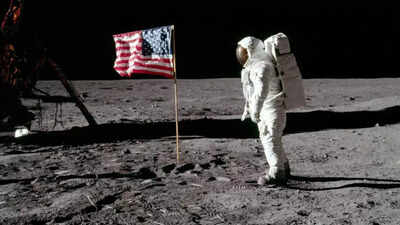
According to the American Presidency Project, the duo spent two and a half hours outside, collected 21.5 kilograms of moon rocks, planted an American flag, and spoke with President Richard Nixon on the radio.Nixon smiled from the White House, saying: “In one priceless moment in all of human history, all the people on this earth are truly one: one in their pride in what you have done, and one in our prayers for your safe return to Earth.”As in excerpts shared by NASA in the Apollo 11 Record, astronaut Edwin “Buzz” Aldrin Jr. walks near an eagle’s leg during an Apollo 11 extravehicular activity (EVA). This image was taken with the 70mm lunar surface camera by astronaut Neil A.
Armstrong, Apollo 11 commander.Meanwhile, Collins orbited alone in the command module Columbia. “I was the loneliest person in the entire universe, at least according to the newspapers,” he joked. “Actually, I was quite happy to be behind the moon until mission control stopped. Then I felt a little calm and peaceful.”
Trip Home and Splashdown
After 21 hours and 36 minutes on the surface, Armstrong and Aldrin lifted off to dock with Collins.
They landed in the Pacific Ocean on July 24, 1969. 195 hours, 18 minutes and 35 seconds after launch, 13 miles from the USS Hornet. Bad weather meant the site was moved 250 miles, ensuring safety.The crew was isolated for 21 days to check for any lunar errors, and the crew appeared as icons. This feat opened the doors for Apollo 12-17 even more.
A lasting legacy
Jim Lovell, at a 2014 reunion, summed it up this way: “The legacy of Apollo is, if you set your mind to do something, bring everyone together and everyone agrees that we should get it done, then we move forward, and it becomes something we can all be proud of.”With Armstrong dying in 2012 at the age of 82, and Collins in 2021 at the age of 90. Aldrin, 93 (as of 2026), remains the oldest living moonwalker along with David Scott (91), Harrison Schmitt (88), and Charles Duke (87).The Apollo 11 moon landing inspires today’s dreamers, proves bold goals and unites us.