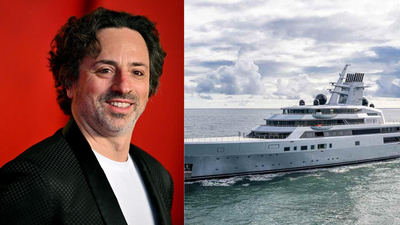
For many of the world’s richest people, a luxury yacht is the ultimate escape from work, offering privacy, luxury and the opportunity to disconnect from work. But Sergey Brin, co-founder of Google, appears to have taken a completely different approach.
His 466-foot (142.1 m) superyacht Dragonfly is said to include an entire business deck, allowing him to continue working while sailing across the world’s oceans.
Built by renowned German shipyard Lürssen and delivered in 2024, the ship combines luxury and function, reflecting Brin’s reputation as a hands-on entrepreneur who returned to Google’s AI efforts after the generative AI boom.
Instead of just being a luxurious retreat, Dragonfly actually became a floating headquarters.
A luxury yacht designed for business, not leisure
Dragonfly is among the largest private yachts ever built by German shipbuilder Lürssen. It is 466 feet (142.1 meters) long, was delivered in 2024 and is among the company’s largest projects. The yacht was designed by renowned naval architect Germain Freres, while Italian design studio Nauta Design designed the interiors and outdoor social spaces.
Unlike most superyachts, where entire decks are reserved for guest cabins, spas or entertainment, Dragonfly is said to devote a significant portion of the ship to productivity. Lürssen confirmed that the yacht includes a dedicated business deck that includes a private office, gym, games room and hidden helicopter hangar, making it one of the most unusual work spaces ever built at sea.
Why Dragonfly’s portfolio stands out
The dedicated desk is Dragonfly’s hallmark.
Although Lürssen has not revealed its exact dimensions, it is believed that the workspace takes up a significant portion of the work surface. Industry observers estimate that the office, along with its surrounding facilities, represents a significant commitment to creating a functional workplace rather than just another luxury lounge.A hidden helicopter hangar supports this concept. Built within the yacht’s superstructure, it allows passengers to arrive or depart quickly without relying on ports or tenders.
While detailed interior plans have not been announced, the combination of private office and aviation facilities reflects a convenience-focused design for the owner who manages global business interests.
Hybrid architecture under luxury
The Dragonfly is powered by Lürssen’s advanced diesel-electric hybrid propulsion system. The setup combines diesel engines, controllable propellers, power take-off and power take-off (PTI/PTO) units and an azimuth electric motor to improve efficiency and operational flexibility during long flights.Hybrid propulsion can also reduce machinery noise and vibration when operating in electric mode, creating a quieter environment on board. Although Lürssen does not specifically describe this as an office feature, this geometry can provide a more comfortable environment for meetings, video calls and focused work while at sea.
Sergey Brin returns to Google’s AI race
Brin stepped down from day-to-day management of Alphabet in 2019, but his involvement has increased dramatically following the rapid rise of generative AI.
Reports indicate that he worked closely with Google’s engineering teams, contributed to the development of artificial intelligence and helped accelerate the company’s Gemini models.His work ethic attracted widespread attention in 2025 when an internal memo, first reported by The New York Times, described 60 hours a week as the “sweet spot for productivity.” Brin also encouraged employees working on Google’s AI projects to spend every weekday in the office, arguing that the race toward artificial general intelligence requires extraordinary commitment.
The billionaire who never seems to switch off
Dragonfly seems to reflect Brin’s personal philosophy toward work. Instead of separating work from leisure, the yacht merges the two into one environment. The inclusion of dedicated office, business facilities and advanced engineering indicates that productivity remained a central consideration throughout its design.Today, Brin remains one of the richest people in the world, with Forbes estimating his fortune at $266 billion, although the number changes with market movements.
For someone who oversees investments, AI initiatives, and philanthropic projects, a traditional office may not always be enough. Dragonfly shows how modern technology and luxury can be combined to create a workplace capable of traveling anywhere in the world.
More than just a luxury yacht
Dragonfly isn’t just another billionaire’s luxury yacht filled with lavish amenities. Its hallmark is the way it reimagines what the workplace can look like. By incorporating a full business deck onto one of the world’s largest private yachts, the vessel reflects the changing lifestyles of technology entrepreneurs whose work rarely stops, no matter where they are.While most people view the open sea as a place of disconnection, Brain’s floating headquarters suggests that for some of Silicon Valley’s biggest innovators, inspiration and business endure long after leaving the beach behind.