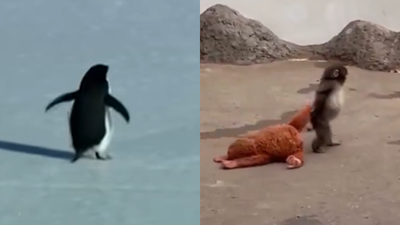
In the age of endless scrolling, these clips seem almost ordinary. A penguin strays from its colony through the Antarctic ice. A little monkey holding a stuffed toy. A panda with unusually dark fur has people discussing genetics and camera filters.Individually, they are moments of the natural world. But online, they become something else entirely: icons, memes, emotional touchpoints, and sometimes global news.In 2026, social media’s obsession with animals has intensified into a cultural trend. Short clips, zoo security cameras, documentary footage and live wildlife broadcasts are now turning into viral stories followed by millions with an intensity of episodic drama.
Unlike previous internet sensations that were based solely on “attractiveness,” this year’s viral animals carried more complex narratives. This phenomenon is not entirely new. The Internet has long turned animals into celebrities, from Grumpy Cat to Knut the polar bear. But the viral wildlife of 2026 reflects a different ecosystem – algorithm-driven virality, sarcasm-filled meme culture, and a generation that increasingly reads human emotion into animal behavior.
From the philosophical ‘nihilist penguin’, who became a symbol of existential dread, to the orphaned Japanese macaque ‘Punch’, who captured global sympathy as viewers followed the story of a young ape struggling to fit in with his group, and panda clips spread on social media, adding lighter moments to the collective mood online, the animals of 2026 reveal as much about the humans online as the creatures themselves.
But behind the memes and millions of views lies a deeper question: Why do certain animal moments resonate so strongly with people online?Experts say viral animals often reflect human emotions more than animal reality. “People explain animal behavior through their own experiences,” notes Delhi-based psychologist Sanghamitra Arya, cautioning against reading human intent into natural actions. “One of the reasons people relate to these videos is that it takes them back to their childhood, and it reminds them of all those stories and interactions that you heard about the place where this character (animal) would be the only one that could talk and would teach you something… and that leaves an impact on your mind,” she adds. However, in an age of fragmented attention spans, these animals have managed to capture the world’s attention, turning brief snapshots into cultural talking points.
Why are viral animals important?
At first glance, these trending moments seem insignificant, online wonders that briefly dominate timelines before disappearing.In the case of the baby macaque, Punch, global audiences responded to what seemed like a relatable story of unity and resilience.
Likewise, the viral penguin clip has been interpreted as a symbol of exhaustion, rebellion or existential despair, although scientists stress that the animal’s behavior likely has more mundane explanations such as disorientation or illness.Dr Ishita Mukherjee, a Gurgaon-based psychologist, explains what could be behind the popularity, “Emotional videos give people an instant emotional boost, and in a world where people are constantly exposed to stress, anxiety, depression and heavy information, these clips are simple, light, relaxing and easy, so they act as an emotional reset.”The result is a digital feedback loop: animals provide the raw footage, and the Internet provides the meaning.
The “Nihilist” Penguin – a meme born of isolation
One of the most widely shared wildlife clips of 2026 is a scene from director Werner Herzog’s 2007 documentary Encounters at the End of the World.The footage shows the Adelie penguin leaving its colony and walking inland towards the remote mountains of Antarctica, about 70 kilometers from the sea and far from the species’ food sources.
In the documentary, this moment was intended to illustrate the strange and sometimes tragic behavior that occurs in the wild. Herzog’s account suggests that such journeys could lead to death.After nearly two decades, the clip resurfaced on platforms like TikTok, Instagram, andCaptions ranged from “He knows something we don’t know” to “Getting away from it all.”
Penguin has become shorthand for burnout, quiet rebellion, or rejection of societal expectations.The meme spread so widely that it eventually crossed over into politics. US President Donald Trump even posted an AI-generated image during his Greenland rant, depicting Trump walking with a penguin, mirroring the viral meme and expanding its reach further.
But the documentary cautioned against introducing philosophical meaning into this behavior.
Penguins sometimes wander inland because of disorientation, illness, or navigation errors, not because of an existential crisis.
However, for the Internet, the symbolism has proven irresistible.“Such animals and videos reflect what people need emotionally at the moment, which is a lot of humour, comfort and a break from the serious monotonous life. So oftentimes these animals become characters through which people express their daily feelings like frustration, annoyance, boredom or joy,” says Dr Murkherjee.
Monkey Punch: Adopted Child on the Internet
If the nihilistic Penguin represents sarcasm and dark humor, Punch the Monkey has become the emotional heart of viral animal culture in 2026.Punch is a Japanese macaque born in July 2025 at the Ishikawa City Zoo near Tokyo. Shortly after his birth, his mother abandoned him, a phenomenon that can occur among primates due to stress, inexperience, or environmental factors.Caretakers manually lifted the infant and presented a large stuffed orangutan toy to soothe him and simulate the physical contact a mother would normally make.
Pictures of the little monkey clinging to the plush toy quickly spread across the Internet.Within days, Punch had become an international sensation. The hashtag #HangInTherePunch began trending on social media as users followed updates on his attempts to blend in with the zoo’s macaque troop.Visitors began queuing outside the zoo in large numbers. At one point, attendance doubled compared to the previous year, according to Japanese media. In early videos, Bunch appeared anxious and withdrawn, sometimes being pushed away by other apes. But subsequent updates showed progress: He was grooming, playing and even riding on the backs of macaques as he gradually integrated into the group.
For many viewers, Punch’s story reflected the human experiences of rejection and belonging, a narrative arc that social media has eagerly amplified.Arya agrees: “There is this magical connection between animals being so wise, and being able to relate to human behavior, and oftentimes their actions are in harmony with human actions, like finding comfort in a plush doll, like a human running to their mother or partner or siblings, and that brings up so many emotions.”
Su Jin Xia And the viral charm of the panda
Pandas have long been an Internet favorite, but in 2026, a panda going viral under the name Su Jin Zia caught attention due to its unusual dark fur pattern.Pictures of the animal spread quickly across social media platforms, with users discussing whether the panda’s dark black color was due to lighting conditions, genetics, or digital filters.
Although details about individual pandas remain limited, the widespread discussion illustrates a broader pattern — the Internet’s enduring fascination with pandas as a symbol of conservation and Internet cuteness. It attracted animals Giant pandas have historically drawn global attention not only because of their rarity but also because they occupy a unique place in geopolitics and conservation diplomacy. From live zoo broadcasts to breeding programs, individual pandas often gain international fan bases.In the era of short video, this fascination has intensified.
Other animals dominate the schedules
The viral animal ecosystem rarely orbits a single star.
Instead, it functions as a rotating cast of characters whose popularity rises and falls depending on algorithmic momentum.Among the most prominent examples circulating in recent years are:
Mo Ding, the little screaming hippopotamus
A pygmy hippopotamus named Mo Ding, born at Khao Khiaw Open Zoo in Thailand, has caused an internet sensation after videos of the tiny animal screaming and interacting wildly with zookeepers went viral on social media.
The clips quickly evolved into interactive memes used across platforms.
Zoo animals and celebrities live broadcast
Live wildlife broadcasts have also produced viral moments such as otters and penguins interacting unexpectedly or zoo animals forming unusual friendships.In many cases, the animals themselves are not unusual. What changes is the framework: short clips, looping videos, and funny captions that turn simple behavior into storytelling.
The psychology behind viral animals
There are several psychological factors that explain why animal stories go viral online.
anthropomorphism
– The tendency to attribute human feelings to animals.When viewers saw Punch clinging to a stuffed toy, they interpreted that moment through familiar human narratives: abandonment, comfort, and resilience. Likewise, the penguin clip became a metaphor for existential anxiety because viewers projected human concerns onto animal behavior.
Visual storytelling
Animals communicate without language, making their actions universally understood across cultures.
A short clip that does not require translation.Finally, there is the algorithmic incentive structure of social media. Content that elicits strong emotional reactions, whether humor, empathy, or curiosity, tends to spread more widely.Animals generate those reactions reliably.According to Dr. Murkherjee, this can also be attributed to “they feel real and uncomplicated. Psychologically people are also drawn to very real moments that don’t require a lot of thought. In a fast-paced, immersive digital world, these videos feel very calming and stress-free.”
The paradox of conservation
While viral fame can raise awareness about wildlife, it also creates tensions.On the one hand, viral animals can generate funding and public interest for conservation or zoo programs. For example, Punch’s popularity has led to an increase in visitors to the Ichikawa City Zoo and increased interest in primate welfare.On the other hand, the Internet’s tendency to humanize animals can obscure scientific facts. Wildlife experts often warn — as one does in Herzog’s documentary — that unusual behavior, like a penguin wandering indoors, doesn’t necessarily have a deeper meaning.Narratives created online often talk more about human emotions than animal behavior.
Telling new wildlife stories online
What makes Viral Animals in 2026 special isn’t just the animals themselves, but the speed with which stories take shape around them.A short video can become a global story within hours. Memes, hashtags, comment threads, and reaction videos expand the story beyond its original context.In the case of Punch, the story of the little zoo became a universal emotional one.
With the Penguin, an old documentary clip turned into a philosophical meme.In each case, the Internet was not just monitoring wildlife, it was rewriting the story.
The animals we project ourselves onto
Ultimately, this ubiquity reveals a simple truth: that humans see themselves in animals.In the digital age, wildlife doesn’t just live in forests, oceans or polar ice.Inhabit timelines.And sometimes, for a brief moment, the entire Internet goes along with it.