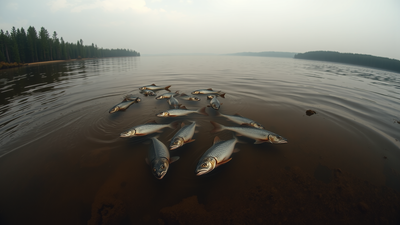
Freshwater lakes across North America and Europe have been quietly changing color for decades, and not in a good way. An increasing number of rivers, ponds and lakes are turning dark brown, a phenomenon scientists call “freshwater browning.”
To the untrained eye, this may not seem alarming. But a comprehensive new study published in the journal Biological Review confirms what ecologists have feared for years: that this browning shift is actively reshaping fish communities in ways that could have serious, long-term consequences for aquatic biodiversity, freshwater fisheries, and millions of people whose livelihoods and recreation depend on healthy lakes.
What is freshwater browning, and why do lakes turn the color of tea?
Freshwater browning refers to the increased concentration of dissolved organic matter and iron in the lake water, giving it a brown, tea-like tint.
This process is not random, but is driven by a combination of climate change, changing land use patterns, and declining acid rain. As global temperatures rise, warmer conditions accelerate the decomposition of organic matter in the surrounding soil, releasing carbon compounds that leach into water bodies through increased rainfall and runoff.
The decline in acid rain, which previously prevented the release of dissolved organic carbon from soils, has increased the load on freshwater systems.
According to the study led by McGill University, this darkening of the water is not just a cosmetic change, but fundamentally changes the physical and chemical environment that fish and other aquatic organisms depend on. Less sunlight penetrates the browner water, reducing underwater visibility and disrupting food webs that begin with photosynthetic organisms near the surface.
How browning in freshwater causes declines in populations of trout, bass, perch, and whitefish
The study, led by Alison Roth, a postdoctoral fellow at McGill University now based at the University of Missouri, analyzed fish population data from 871 lakes spanning North America and Europe.
The results were stark. Darker waters have been consistently associated with declines in populations of some economically and ecologically valuable freshwater fish species: lake trout, lake whitefish, yellow perch, largemouth bass, and smallmouth bass.The researchers found that these species tend to rely heavily on vision for hunting and navigation. In dark brown waters, their ability to detect prey, avoid predators, and compete for food is greatly reduced.
The result is not only smaller numbers, but also slower growth rates of individual fish, meaning that fish living in brown lakes are often smaller and less healthy than those in clear waters.Interestingly, brook trout have been shown to be the exception among trout species, as their abundance shows no significant link to browning in the water. Scientists are still working to understand why brook trout appear to be more tolerant of dark conditions than their lake trout counterparts.
Why do Northern Pike and Walleye thrive in dark lakes while others struggle?
Not all fish lose the battle against water discoloration. The same study found that northern pike and walleye became more abundant in darker lakes due to sensory biology. The gray-eyed eye has a specialized reflective layer in the retina called the tapetum lucidum, which allows it to collect more available light and see effectively in low-visibility environments. Meanwhile, northern pike rely on a highly developed lateral line system, a sensory organ that runs along the sides of their bodies and detects vibrations, pressure changes and water movements, allowing them to hunt without having to clearly see their prey.In separate research on 303 Canadian lakes, the McGill team also found that fish communities in browner lakes were significantly more likely to contain species with larger eyes, a trait that gives an evolutionary advantage in darker, darker conditions. This suggests that changing the color of freshwater to brown changes not only the number of fish in the lake, but also the types of fish that can survive there at all.
The rippling ecological and economic impacts of changing fish communities in freshwater lakes
The implications extend beyond biology. Trout, bass, perch, and whitefish are not only ecologically important, they are also the backbone of the multibillion-dollar-a-year recreational fishing industries throughout North America and Europe.
Lakes long known for their trout or bass fishing could see these species quietly disappear from unstocked waters over time, changing the nature of entire fishing communities and lakeside economies.The environmental impact is equally serious. Fish are not passive inhabitants of the lake; They actively shape it. As Erin Gregory Ives, co-author and professor of biology at McGill University, explained, the fish affect populations of other organisms throughout the lake.
When dominant species decline, it creates a cascading effect: predator-prey dynamics change, algal and invertebrate populations change, and the overall balance of the freshwater ecosystem is disrupted.
Lakes that lose species diversity may become more vulnerable to more environmental stressors, including extreme temperatures and invasive species.The published findings, which also set out a framework for understanding how browning affects fish from the individual level down to entire communities, is expected to guide freshwater biodiversity research and conservation policy for years to come. What once seemed like a simple problem of discoloration in remote, wild lakes is now recognized as a quiet but significant restructuring of freshwater life as we know it.