

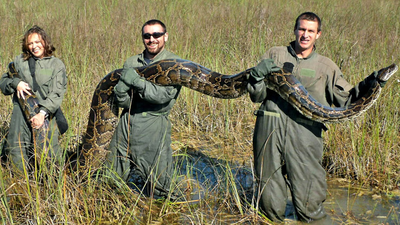
Burmese pythons have already gained a reputation as one of Florida’s most destructive invasive species, decimating populations of native mammals and disrupting ecosystems across the Everglades.
But scientists have now discovered another surprising way these giant snakes may be changing the landscape. New research suggests that reptiles inadvertently transfer seeds after eating birds and mammals that consume the fruit, allowing the plants to spread into new areas. The findings reveal that the impact of Burmese pythons extends beyond predation and could impact plants that thrive in South Florida’s wetlands, potentially reshaping the Everglades in ways that researchers are only beginning to understand.
Scientists have found seeds inside the digestive system of a Burmese python
These results come from a study published in the Journal of Zoology. The research was conducted by scientists from the University of Florida, the US Geological Survey and the Southwest Florida Conservation Service.Using digestive samples collected from Burmese pythons in South Florida, the researchers identified 25 different types of seeds within the snakes. These included seeds from native plants such as cabbage palm and creeping cucumber.
The team concluded that reptiles may serve as accidental carriers of seeds after eating birds and mammals that consume the fruit.In the study, the authors write that invasive creepers can affect seed dispersal in several ways. They note that snakes may spread seeds directly by eating them, indirectly by preying on animals that have already eaten the seeds, and through what scientists call “secondary seed dispersal.”In simple terms, this means that a snake can swallow an animal containing seeds and later deposit those seeds elsewhere, allowing the plants to spread into new areas. Although this process is episodic, researchers say it could affect how plants are distributed throughout the Everglades.
Nearly 40 percent of some of the seeds survived the digestion process
The study found that seed movement was not just a theory. Germination experiments showed that approximately 40% of the cabbage palm seeds survived passage through the snake’s digestive tract and subsequently germinated successfully.This means that Burmese pythons can help both native and invasive plants establish themselves in places they might not reach otherwise. Scientists say this unexpected role could have long-term consequences for sensitive habitats throughout South Florida.
The snakes have already been destroyed Local wildlife
Burmese pythons are among the most destructive invasive species in the Everglades. Over the past two decades, the numbers of raccoons, rabbits, foxes and many other mammals have declined as snakes have spread throughout the region.Many of these mammals once played an important role in transporting seeds through the ecosystem. As those animals disappear, snakes may take over part of that function, although researchers warn that replacing native seed dispersers with a giant predator could have unforeseen consequences.
Researchers say the hidden effects of invasive species are often overlooked
Invasive species “reshape ecosystems in ways that are not always obvious,” the authors said. While Burmese pythons are known to eat native animals, their impact may extend beyond the species they directly kill.“Our study links snake ecology to removal efforts,” Melissa Miller, a University of Florida researcher involved in related snake studies, previously said, adding that long-term research is necessary to better understand “mysterious, long-lived species like Burmese pythons.”Scientists say discoveries like these show that invasive animals can alter ecosystems through multiple pathways, creating ripple effects that may take years or even decades to fully understand.The study highlights the complexity of biological invasions. Scientists are still discovering the many ways invasive species impact ecosystems, and some impacts may remain hidden for years.Understanding these interactions can help conservationists better protect the Everglades, one of the world’s most important wetland ecosystems. Researchers say that even after decades of studying Burmese pythons, giant snakes are still revealing unexpected ways in which they can change their environment.