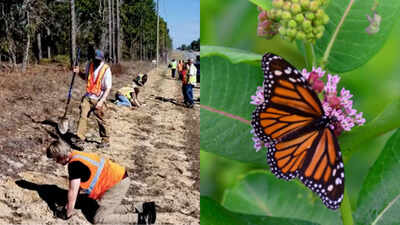
Officials in Florida have planted 15,000 milkweed plants along roadsides to help monarch butterflies survive.
If you’ve been driving along rural roads in North Florida lately, you may have noticed new signs of wildflowers and patches of orange flowers growing on the side of the road. These are not just for decoration.
They are part of a larger effort to conserve monarch butterflies and many other pollinating insects.Scientists from the Florida Museum of Natural History and the Florida Department of Transportation have planted thousands of milkweed plants along roadsides across North Florida. The project aims to create safe feeding and breeding areas for monarch butterflies, whose numbers have declined over the years.The team has already planted about 15,000 milkweed plants, and initial results have been encouraging. Scientists say the plants are growing well, and monarch butterflies have already begun visiting them, Science X reported.
Butterfly trails
The project is part of a broader program led by the University of Illinois at Chicago. The idea is to convert unused land along roads, railway lines and power lines into nature corridors where monarch butterflies and other pollinators can find food and move safely between habitats.
Florida joined the voluntary program in 2024. Under the agreement, the Florida Department of Transportation plans to manage about 10,200 acres of roadside land in ways that support wildlife.The administration first awarded a $150,000 grant in 2023 to a research team to plant, grow and monitor 9,000 milkweed plants over three years. The project has now been extended until 2029, allowing another 6,000 plants to be added.“It’s been a lot of work but it’s really exciting to see,” said Garrett Daniels, curator of lepidoptera at the Florida Museum of Natural History. “We’ve had good success setting up plants, and we’ve seen monarchs use plants already in the field.”
Why milkweed matters
Milkweed is much more than just another roadside flower. It is the only plant on which monarch butterflies lay their eggs. Once the eggs hatch, the larvae, also called caterpillars, feed solely on milkweed leaves.
Without these plants, monarch butterflies cannot complete their life cycle.Milkweed flowers also produce a lot of nectar, the sweet liquid inside the flowers that many insects feed on for energy. Bees, butterflies, moths, wasps, flies and many other insects depend on nectar, making milkweed an important food source.Roadsides are already maintained by people, so using them to support wildlife makes sense, Daniels said. “It’s a no-brainer,” he said. “We don’t have enough conservation land to sustain pollinator populations over time in many areas, so we have to look at the environments we, as humans, manage every day. Roadsides are managed regardless, so why not do it in a way that gives greater benefits?”Milkweed belongs to the plant family called Apocynaceae. Many plants in this family produce naturally occurring toxic chemicals known as glycosides and alkaloids.
These chemicals help protect plants by making them difficult or dangerous for animals to eat. Most animals avoid these plants, but monarch butterflies have developed special changes in their bodies that allow them to survive the toxins.
Assistance for long trips
Adult monarch butterflies travel remarkable distances. A single butterfly can fly more than 100 miles (161 kilometers) in one day. These long trips require a lot of energy. Butterflies stop regularly to feed on the nectar of flowers growing in gardens, natural habitats and open spaces.New roadside milkweed patches provide additional places where butterflies can rest and feed during these trips.The benefits are not limited to butterflies. More flowering plants also provide food for bees, moths and many other pollinators. Birds and other wildlife that feed on insects may also benefit.Scientists say nearby farms that grow crops like berries and watermelon could also benefit because more wild pollinators may visit the fields and help pollinate the crops.
Find the milkweed species
The project is also helping scientists figure out which types of milkweed grow best next to roads. The researchers started with six native species, but now mainly use pine forest milkweed (Asclepias humistrata) and butterfly weed (Asclepias tuberosa). Both grow naturally in dry, sandy soil, making them well-suited to road conditions.“Both are upland, sand-loving species that are typically found in pinelands and sandhills,” Daniels said.Growing pine trees in pine forests is not easy. The plant develops a long main root called a taproot, which needs deep potting as it grows. Since these plants are not widely sold, the research team created its own supply chain.Scientists collect seeds from wild plants before they are carried by the wind. The seeds are then sent to the University of Florida Native Plant Nursery, where staff and volunteers grow the seeds into plantlets.“The last batch of seeds we gave them had about 98% germination, and we’ve seen good establishment of these plants in the field,” Daniels said. “Native Plant Nursery has been an invaluable partner in this project.”The team purchases butterfly weeds from a commercial nursery before planting all the young plants over the winter, when cold weather helps them settle into the soil.