

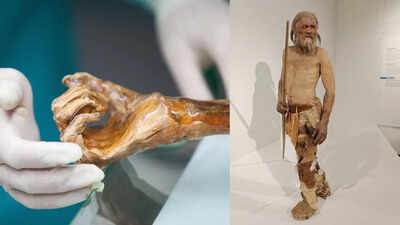
In a cold storage facility in northern Italy, Ötzi the Iceman lies behind controlled glass and steel, kept at a constant temperature that mimics the glacier that once enclosed him. It has been there since 1991, when hikers found what appeared to be a fresh corpse lodged in the melting snow of the Ötztal Mountains.
The assumption did not last long. What followed was the slow identification of a man who died more than five thousand years ago, preserved in an eerie perfection that still looks a little out of place in modern laboratory rooms. Skin, tattoos, fragments of clothing, and even traces of his last meals were drawn and re-examined. Now attention has turned again, this time toward something less obvious: the microscopic life still attached to it, and whether any of it is doing more than just surviving.
It is 5300 years old The oldest mummy in Europe Reveals microbial echoes inside
Ötzi’s remains have always carried a sense of suspended time. The cold slowed the putrefaction process almost to a halt, but it did not freeze the body in a state of absolute stillness. And within that boundary between conservation and change, microbes have become the latest focus, according to a study published in Springer Nature titled “The Snowman’s Microbiome: Revealing Millennia of Microbial Diversity and Continuity.”What makes the current interest unusual is not simply the presence of bacterial or fungal traces, but rather the possibility that some of them are not just traces.
They appear to have survived in forms that blur the line between ancient remains and ongoing biological activity, despite predictions that such conditions would have brought everything to a halt long ago. To get closer to what was actually living on or inside the mummy, the researchers collected samples from all over the surface of the body and from fluid trapped within the preserved tissue.
Ancient soil from the original discovery site has also been brought back into the picture, along with data from previous examinations of stomach and intestinal material.The difficulty is untangling what belonged to Ötzi’s original microbial community and what arrived later, either during recovery from the ice or during decades of work at the museum. DNA and RNA sequencing have provided a way to sort this mixture, although this results in blurred edges rather than clear lines. Some of what emerged clearly indicates ancient origins, parts of microbial communities that appear to have been part of his body during his lifetime.
Other signals seemed more recent, shaped by cold environments and recent exposure.
Microbial effects between dormancy, survival and glacial transport
Among the most interesting findings were yeasts that seemed well suited to extreme cold. These organisms resemble lineages found in polar regions, including Antarctica, and appear to be adapted to conditions that slow most biological processes to an almost complete halt.Their presence raises the quiet possibility that they did not begin with the man himself, but arrived through the icy environment that eventually covered him.
In this sense, the ice not only preserved Ötzi; They may have introduced their microbial passengers into the mix. Besides, there were microbial fingerprints that appeared less variable, suggesting a continuity extending much further.
It is not easy to determine whether this continuity represents dormant survival or intermittent renaissance. Data do not settle the question as much as they leave it hanging.
Chemical conservation and unexpected resilience of microbial life
There is another layer that complicates the picture. After the discovery, parts of the body were treated with chemical agents intended to limit biological growth and stabilize the preservation process.
One of these compounds, phenol, is toxic to many organisms. However, some of the identified yeasts appear to be able to degrade phenol itself. This raises the uncomfortable idea that conservation efforts, designed to prevent activity, may have inadvertently favored a small population of resilient microbes able to withstand or even exploit treatment.
It’s a narrow technical detail, but it changes how the body is viewed inside the cryogenic chamber.
Not a closed site, but one where chemistry and biology still intersect in unexpected ways.
When ancient preservation shows signs of slow biological turnover
Samples collected at distant intervals show slight differences. Some cold-adapted species appear to have increased slightly over time, suggesting that everything that exists is not completely static. Growth, if it occurs at all, will be extremely slow, measured in ways that do not resemble natural biological cycles. This idea is strangely at odds with the assumption that a 5,000-year-old body should be completely biologically inert.
However, the patterns point to something less stable. Not life in the usual sense of a thriving ecosystem, but not complete silence either.Ötzi continues to sit in that unstable space between artefacts and environment. The ice that once halted decomposition now functions as a kind of controlled habitat, and the microbes associated with it reflect ancient biology and modern interventions. For now, the Iceman remains what he always was: a preserved human being, yes, but also something less visible, bearing traces of biological activity that refuses to fit neatly into the idea of a finished past.