

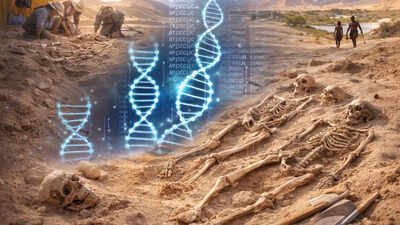
The discovery of fossilized human remains in the Sahara desert marked a new era in research into the history of human evolution. Researchers have discovered skeletons dating back 7,000 years that do not belong to any existing breed.
This discovery sheds light on unknown human races that existed on the African continent but became extinct without leaving any trace of their existence.Fossilized human remains were discovered in the heart of the desert; However, in its heyday the Sahara was home to many human communities. This phase of history, known as the Green Desert, saw human migration, hunting, and settlement within lands that remain uninhabited today.
DNA analysis has provided new insights into human evolution during this period.
Skeletons in the Sahara provide genetic evidence for the existence of an extinct human group
These skeletons have been discovered at various archaeological sites in the desert, and can date back to about 7,000 years ago. Scientists analyzed DNA samples from these skeletons and compared them with samples from living humans.The research, titled “Ancient DNA from the Green Sahara reveals North African ancestral lineage,” published in the journal Nature, provides an analysis of the genetics of these people.
According to the analysis carried out in this paper, it turns out that these ancient people belonged to a certain race of humans that no longer exists in today’s world.
What makes this DNA different from modern human DNA?
An important feature regarding this particular discovery is that their genes do not appear to fit into any of the currently existing populations. Although modern humans are all related to each other, this group of people appears to have had its own distinct genetic profile.This is not to say that this was a completely different genre; Rather, it implies that these people belong to a lineage that evolved separately from others. Over time, this lineage dwindled or mixed with other populations, leaving behind little evidence in our genetic makeup.
Life in the green desert
The Sahara was not always a desert. Nearly 7,000 years ago, it had lakes, plant life, and animal life, making it a friendly environment to live in.These ancient humans likely relied on hunting, gathering, and fishing to survive. The presence of water bodies and fertile lands would enable them to form communities.However, due to changes in the climatic conditions of the region, making it dry, these humans had to migrate or adapt, which could lead to genetic dilution.
Why is this discovery important for human evolution?
This discovery is important because it shows the complexity of human history, which has turned out to be more complex than initially thought.
Instead of moving in a linear progression, human evolution has involved the interaction, separation, and even extinction of different populations.The new lineage means that other lineages may exist but have not yet been discovered. The discovery of this lineage also shows that Africa had many different and organized groups living there long before any written history was recorded. This information can help determine how people migrate over time.
Studying DNA in the desert reveals an untold story about early human groups
The discovery that people who lived 7,000 years ago in the desert had unique DNA raises questions about many theories regarding human origin. It shows the existence of different groups in ancient Africa that could not survive to this day.More importantly, it shows that the history of the human race has not yet been completely written. Each new piece of evidence helps us discover new facts about our past.