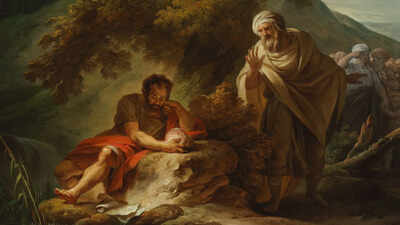
“If your desires are not great, less is more.”
Imagine standing in front of a vending machine or browsing an online marketplace, surrounded by thousands of choices created to encourage immediate purchase. A person buys a slightly improved phone, feels a brief moment of happiness, and soon begins to look forward to the next model.
The endless buying cycle is based on a psychological illusion: The belief that wealth is measured only by how much we have.Centuries before the advent of modern consumer culture, a different idea of prosperity was presented. The philosopher Democritus expressed this idea in a simple observation: “If your desires are not great, little will seem too much, for want of appetite makes poverty equivalent to wealth.”This statement challenges the usual definition of abundance. He argues that wealth is not just a financial measurement based on money, property or assets. Rather, it is a mental state shaped by the relationship between what a person wants and what he already has. As human desires become smaller, the amount needed to feel satisfied also changes. The quote remains meaningful today because it speaks directly to the fatigue of chasing endless material goals, suggesting that true financial and mental freedom comes from controlling personal desires rather than amassing more possessions.
Atomic on the market
This idea comes from Democritusan ancient Greek philosopher who lived around 460 BC to 370 BC in the city of Abderra. He is best known in the history of science for helping to develop the atomic theory, which proposed that everything in the universe consists of small, indivisible particles moving through empty space. However, his ethical writings focused primarily on understanding the human mind. The people of his time gave him the nickname The philosopher laughed For he has traveled through the ancient world, observing man’s ambitions and concerns with a sense of quiet amusement.The surviving ethical writings of Democritus have been preserved by later writers such as Stobaeus. They show that these ideas were directed at ancient Greek society which was experiencing rapid commercial growth, bringing large amounts of foreign luxury goods, wealth and political competition.While living through the social conflicts of the Peloponnesian War, Democritus saw rulers and merchants ruin their lives while chasing power and property.
He did not favor a life of extreme sacrifice or a complete rejection of comfort. Instead, he believed that the main goal of human life was hydration, a state of happiness, balance, and inner peace. By keeping desires in check, people can protect themselves from the uncertainty of markets and the pressures of constant competition.
Adequacy ratio
From a philosophical point of view, this teaching challenges a key idea in modern economics: that human desires are unlimited while resources are finite.
Democritus proposed another way to deal with life. If a person learns to control and limit his desires, the feeling of inferiority disappears. The relationship between desire and possession means that a person who has very few desires can feel the same sense of security as a wealthy person who has everything he needs.This idea influenced later philosophical schools. The Epicureans developed a similar view of pleasure by separating desires into those that are natural and necessary, such as food and shelter, and those that are unnecessary, such as fame, luxury, and status.It is also associated with ideas of Stoicism. Epictetus famously said that wealth does not come from having more things, but from wanting fewer things. By recognizing desire as a major source of human stress, ancient philosophers understood that a person with great wealth and endless desires could still feel poor because he was always afraid of losing what he had and was constantly searching for more.
Break the pleasure treadmill
Applying this philosophy in 2026 provides a direct response to the idea of pleasurable walking, a psychological idea that has been studied by researchers such as Philip Brickman and Donald Campbell.
He explains that people quickly adapt to higher levels of consumption and return to their previous level of happiness, regardless of how much wealth they acquire.In today’s financial independence movement, this ancient idea supports simplicity and intentional lifestyle choices. Financial experts who study early retirement patterns have found that people who intentionally reduce their annual expenses can achieve financial independence much earlier than those with high incomes who continue to increase their spending.
The practical lesson is simple: reducing the desire for status objects reduces the need for stressful, high-pressure occupations.The same principle applies to modern technology. Digital companies design platforms to create endless demand through endless scrolling and personalized ads. People who practice digital minimalism by limiting their technology use to basic tools report lower levels of anxiety.
They replace the constant search for attention and new information with greater satisfaction in their immediate surroundings.
The art of humble desires
The lasting value of this philosophy comes from its simplicity. It doesn’t require people to give away all their money or completely separate themselves from society. It just requires regularly asking yourself what is truly necessary for a good life.Modern markets are designed to maximize human desires. Choosing to keep these desires limited allows everyday objects to become sources of real benefit rather than symbols that encourage the next purchase.
By associating wealth with mind control rather than the size of a bank account, people become less affected by financial fear and uncertainty.Diogenes Laertius recorded that Democritus lived to a ripe old age, spending his final years writing books in a small garden outside his city. He remained quite satisfied with the limited resources he needed while continuing his search to understand the universe.