

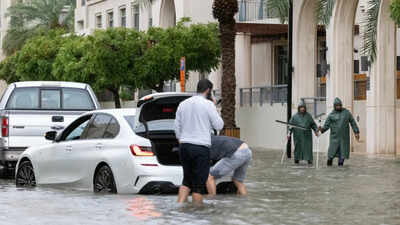
UAE Rainfall Forecast: When commuting time is calculated as working hours in the UAE
As torrential rains and unstable weather disrupted daily life across the UAE, one question took center stage for thousands of employees:If your commute is delayed due to rain, does this time count as working hours? The answer is not as simple as yes or no.
It lies at the intersection of employment law and evolving workplace safety and flexibility policies and understanding it can make a real difference to your rights as an employee.
General rule: Commuting is not work time in the UAE
Under the UAE Labor Law, the basis is that travel time between home and office is not counted as working hours. This applies regardless of:
- Whether you drive yourself
- Use public transportation
- Or take the company bus
Under normal circumstances, your workday officially begins when you arrive at your workplace, not when you leave home.
Exception: When rain changes the rule Workers In the United Arab Emirates
However, during adverse weather conditions such as heavy rain, UAE law makes important exceptions. According to the Ministry of Human Resources and Emiratisation (MOHRE), commuting time can be counted as working hours in specific cases.
- When the delay is due to bad weather conditions: If the weather is officially declared unstable, warnings are issued from the National Weather Center and your commute is significantly delayed, your travel time may be counted as part of your work hours. This is especially important during heavy rain, flooded roads and low visibility.
- If you use company transportation: If the employer provides transportation and the vehicle breaks down, gets stuck in traffic due to rain, or is delayed due to an accident, the transportation time is counted.
paid Working time. This rule is especially important for construction workers, industrial employees and employees living in company accommodation. - If your contract stipulates that: There is also a third scenario that is often overlooked. If your employment contract explicitly includes commuting time as working hours, it legally counts, rain or no rain. This is more common in field roles, jobs that involve long-distance travel and more senior or specialized positions.
At first glance, calculating commute time during the rain may seem unusual, but it is rooted in worker protection. During severe weather, commutes become longer and more dangerous, employees lose productive hours through no fault of their own, and safety becomes a priority over punctuality.
The law recognizes that in such cases, the burden should not fall entirely on the employee.
What about overtime work in the UAE?
This is where things get more nuanced. Even if commuting time is counted, it does not automatically mean that overtime pay and total working hours must comply with UAE limits. Under the Labor Law:
- Standard work = 8 hours per day / 48 hours per week
- Overtime is capped and regulated separately
So, if your late commute increases your total hours worked, whether you get overtime pay depends on:
- Your employer’s policy
- Terms of your contract
- Total hours worked that day
Are UAE companies obligated to provide remote work?
This is one of the biggest misconceptions during rainy periods.
Remote work is not mandatory for private companies in the UAE. However, authorities strongly encourage flexible arrangements during bad weather and employers are urged to prioritize employee safety and well-being.

Rain chaos in the UAE, but are you allowed to work from home?
In practical terms, this means that some companies allow working from home while others adjust appointments and some still require attendance at the office. It is ultimately up to the company’s discretion.Here’s how to implement the rule in everyday situations:
Scenario 1: You are stuck in your private car in the rain in the United Arab Emirates
- Usually it is not calculated
working hours - Unless the weather is officially declared extremely dangerous
Scenario 2: Your company bus in the UAE is delayed due to floods
Scenario 3: You arrive late due to heavy rain warnings in the UAE
- May be counted as working hours (on a case by case basis)
Scenario 4: Your contract in the UAE includes commuting time
- Always calculated, regardless of the weather
The gray area that most employees miss is that although the law provides for exceptions, implementation is not automatic.
In many cases, the calculation of commute time is based on employer approval, internal HR policies, and documentation of the delay. This means that two employees in similar situations may be treated differently. Clarity often comes down to communication, not just the law. The conversation around commute time reflects a broader shift in the workplace in the UAE.

Are you stuck in traffic during rain in the UAE? You might get paid for it
From fixed work hours and strict attendance rules to flexible schedules, remote work options, and safety-first policies, extreme weather events are accelerating this shift and forcing companies to rethink how they measure work.
Under normal circumstances, commuting time is not considered working time, but during rain or disturbance, it may be taken into account but only in specific cases. The main triggers are official weather warnings, employer-provided transportation delays, and contractual agreements.In the UAE, rain not only slows down traffic, it can reshape how you calculate your work day but the rule is not automatic. It lives in a gray area between law and policy, where awareness is important, documentation is important, and understanding your rights is most important, because when the roads are flooded, your time may be more important than you think.