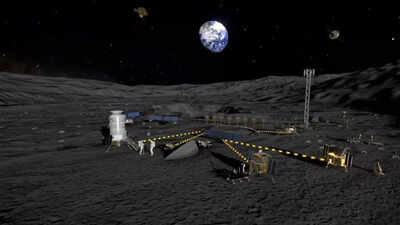
Humans are very eager to study the secrets of the moon, so scientists from all over the world are trying their best to reach a location that can give them an ideal study to read unknown facts about the moon.
The moon race has begun between the United States and China as their scientists find ways to reach astronauts on the moon. The Moon’s south pole is considered a vital landing site and ideal for scientific research. The Aitken Basin – the south pole of the Moon is the largest structure in the entire region. According to the study, China aims to carry out its first lunar mission by sending astronauts to the moon by the end of 2030.
Why is Antarctica the front line in the US-Chinese moon race?
The lunar race between the United States and China is not just about landing and waving their country’s flags, it is also about extracting unknown secrets from the moon.
Antarctica is considered the best place for observation purposes. There is an amazing spot near this pole known as Rimae Bode. A new paper in the journal Nature Astronomy describes this area as a “geological museum.” It does not contain the frozen craters found at the poles or the shaded craters. Instead of polar craters formed during volcanic eruptions, this region has many of the same features as polar craters. The Rimay Boud region contains volcanic plains, ancient highlands and valleys with lava flowing like rivers, all in one place.
Studies say the value of the “scientific gold” at this site comes from the presence of lava deposits (tiny volcanic glass beads created during volcanic eruptions over three billion years ago). The tiny beads of volcanic glass are like time capsules because they contain water and chemicals that form deep in the moon’s mantle during volcanic activity. A lunar lander on China’s planned 2030 lander could address many unanswered questions about the composition of both the Moon and Earth, and could provide a more detailed picture of the Moon’s history than the composition of a polar lander, which is easier to study.
How will China actually land on the surface?
A successful lunar landing by 2030 would use a “staged” method by China rather than a full-scale launch vehicle, as NASA did with the Apollo program. CMSA will send two separate Long March 10 rockets to complete the mission, with the Mengzhou (Dream Ship) manned spacecraft and Lanyue (Moon Embrace) lander each having separate launches according to CMSA’s official mission files. After their successful landing together in lunar orbit, the astronauts will be transferred to the lunar lander for a final landing on the lunar surface.
What is the Tansuo rover and how does it help?
China is currently developing the manned Tansu rover, which will enable astronauts to continue exploring the rugged terrain of the moon. According to a statement from the China Manned Space Agency (CMSA), the spacecraft will accommodate two astronauts traveling through gray lunar soil.The rover will incorporate banking technology to maintain its stability when driving on slippery lunar regolith and steep slopes. It will also be a mobile laboratory for astronauts, each of whom will be able to travel up to 10 kilometers from their lunar lander to obtain “scientific gold” — volcanic glass beads and other mineral samples that could change our understanding of the history of the solar system.