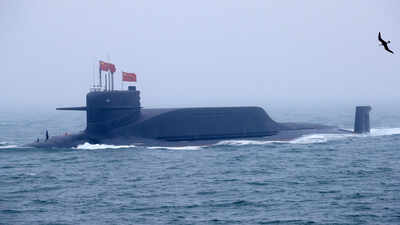
China successfully launches a missile from a submarine. (Image used for representation)
The Chinese military launched a missile from a nuclear-powered submarine into the Pacific Ocean on Monday, state media reported, sparking criticism and concerns from Japan, Australia and New Zealand about Beijing’s military expansion.The New China News Agency (Xinhua) said that a nuclear submarine belonging to the People’s Liberation Army Navy launched the missile carrying a dummy warhead towards international waters in the Pacific Ocean at 12:01 noon local time. She added that the missile fell in “the waters designated for that purpose,” without providing further details about the location.Monday’s launch was part of routine annual training, is consistent with international law and practice, and was not directed against any country or target, according to a short statement from Xinhua News Agency, republished by the Defense Ministry.Australian Foreign Minister Penny Wong said China had notified the Australian government of the planned test, but described the launch as “destabilizing” in the region. Wong told reporters that the test came “in the context of a rapid military buildup by China, which lacks the transparency and reassurance regarding the intentions that the region expects.”The test comes just hours after Australia and Fiji signed a major defense alliance on Monday, committing each country to assist the other if either is attacked.
Beijing and Western powers led by the United States and Australia have been competing for influence in the strategically located island nations for years, and China seeks to expand its economic and security influence across the South Pacific.Beijing and Western powers led by the United States and Australia have been competing for influence in the strategically located island nations for years, and China seeks to expand its economic and security influence across the South Pacific.China adheres to a “no first use” policy of nuclear weapons, but is also actively seeking technology and nuclear weapons as part of its long-term strategy to modernize the People’s Liberation Army. China has a fleet of six ballistic missile submarines and 59 nuclear-powered attack submarines, according to the Nuclear Threat Initiative, a Washington-based think tank.Mark Douglas, an analyst at New Zealand-based ship-tracking firm Starboard Maritime Intelligence, said the test was planned well in advance, and noted that the timing of China’s notification – after Australia and Fiji signed the Ocean Peace Alliance – was “interesting, to say the least”.In response to a question about the defense agreement, Chinese Foreign Ministry spokesman Mao Ning said that China hopes that the countries concerned will respect the independence and autonomy of the island countries and refrain from targeting or harming the interests of third parties.New Zealand Foreign Minister Winston Peters said his country was deeply concerned about the test. “It appears that despite our long-standing concerns about this type of activity, China conducted the test within hours of us being informed,” Peters said in a statement.
“New Zealand considers this an unwelcome and worrying development. We, like our neighbors in other Pacific nations, have no interest in China using the South Pacific as a site for testing missile capabilities,” he added.The Japanese government said it had received notification of the missile launch and urged China to reconsider. “We expressed our grave concern about the increasing activity of the Chinese military,” Tokyo said, adding that Chinese authorities notified the Japanese Coast Guard on Sunday about space debris that may fall within Japan’s exclusive economic zone.In response to regional criticism, Mao said the launch was conducted “safely, in a uniform and professional manner throughout.” “We hope that the countries concerned will not over-interpret the matter,” she said at a press conference in Beijing.It is rare for China to launch long-range missiles into the sea. China last tested an intercontinental ballistic missile in 2024, a launch that highlighted the country’s growing military capabilities.