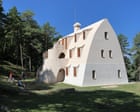
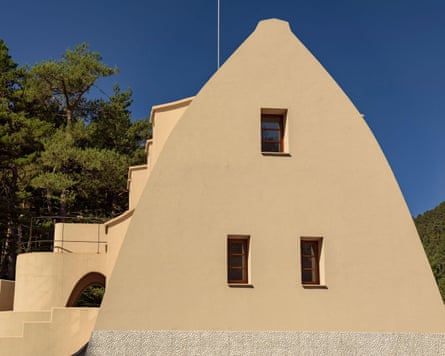
An elegant modernist building in the mountains north of Barcelona, originally built for engineers who were to establish a nearby mine, has been confirmed as the work of Antoni Gaudí, Catalonia’s most famous and distinctive architect.
Xalet del Catllaràs, located 80 miles from Barcelona in Berguida County, was built in 1905 and commissioned by Gaudi’s lifelong patron, Eusebi Güell. Gayle was the owner of a cement company with mines in the area and he needed somewhere to house the engineers, many of them British, who would help extract coal for his factories.
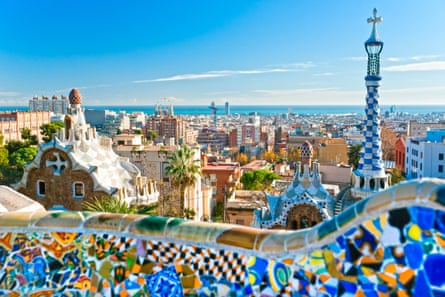
The now-defunct chalet has long been suspected to be the work of Gaudi, but historians have not firmly established the architect. The building contains elements of Gaudí’s naturalistic style, evoking plant and animal forms that would later be expressed in works such as the Parc Güell and the Casa Batllo in Barcelona. The pointed arch structure also represents Gaudi’s most famous work, the Sagrada Familia in Barcelona.
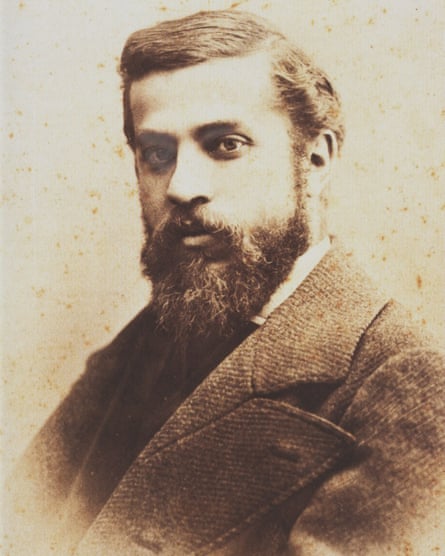
Sonia Hernández Almodóvar, Catalan culture minister, said the attribution was the fruit of “rigorous research of immense value for our heritage” and enriched Gaudí’s legacy on the centenary of his death.
The analysis was carried out by the Department of Catalan Heritage, led by Galerique Santana Roma, Chair of Gaudí Studies. “After much research we have concluded that the Xalet del Catllaràs is the work of Gaudí,” he said. “However, this allegation is strictly limited to the early stages of the project as Gaudi did not supervise work that did not faithfully follow the original design.”
Santana says the process of authenticating an architectural work is very different from that of a painting, and the knowledge gained in the study of the chalet will help research other works attributed to Gaudí.
Gaudí died aged 73 on 10 June 1926, three days after being hit by a tram in Barcelona, and a number of commemorations and exhibitions are planned throughout the centenary year.
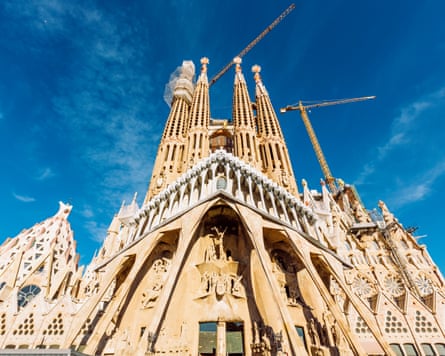
140 years after the project began in 1882, the installation in June of the final elements of the illuminated cross atop the central Jesus Christ tower in the Sagrada Familia will likely have a lasting impact on the city’s skyline.
Initially financed by penitent sinners and more recently by tourism, the completion of the tower will make it Barcelona’s tallest building at 172.5 meters. The Sagrada Familia is already the tallest church in the world since part of its central tower was lifted in October.
Gaudi devoted the latter part of his life to the Sagrada Familia, but little was completed during the architect’s lifetime, and work practically stopped when the Spanish Civil War broke out in 1936. The rise of mass tourism after 1992 helped make Barcelona the final venue for the Olympic Games.
Work on the Glory facade was expected to last another 10 years, and Gaudí’s original plan included the vexing problem of building a grand entrance staircase that would now house 10,000 people and demolish 3,000 apartments.