

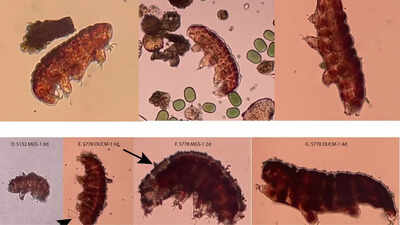
Researchers at Penn State take the unique flexibility of tardigrades, or “water bears,” as a basis for assessing how organisms would respond to and protect Martian resources.
These microscopic animals are known for their ability to survive in the vacuum of space. However, this study focuses primarily on their molecular response to Mars-like conditions and the specific types of proteins that tardigrades use to protect their DNA and cellular structures. Researchers are gaining important information regarding biotechnology applications that could be used in future spaceflights by studying proteins produced by tardigrades.
This information will not only help determine conditions suitable for potential habitation on other planets, but will also provide a model for developing flexible bio-inspired materials that can be used to protect critical infrastructure and biological assets on Mars.
Habitability breakthrough: How ‘water bears’ survive Martian stress
Tardigrades are known for their ability to enter a state of hibernation known as cryptobiosis, but researchers at Penn State are looking into the very specific molecular mechanisms that allow them to do so.
Researchers have identified a new class of “disordered proteins” without a well-defined 3D structure, which appear to form a biological glass around tardigrade DNA and other important cellular components when exposed to extreme stress (e.g., intense radiation or low humidity from Mars-like environments). This glass covering would likely prevent cells from shattering or becoming permanently damaged in an inhospitable Martian-like environment.
Water bears convert proteins into protection
The results of this research suggest that water bears’ survival strategies could be harnessed to create protective layers for valuable resources on Mars. By investigating how these microscopic organisms stabilize their biological materials, researchers hope to create life-inspired coatings that can protect sensitive technologies such as electronics and pharmaceuticals from degradation caused by cosmic radiation and temperature extremes. Effectively moving from passive monitoring of biological systems to engineering “active protection systems” will represent a major shift in how we think about sustaining human life on Mars over the long term.Understanding how tardigrades adapt serves as an experimental framework when developing resilient infrastructure for Mars. The Penn State team noted that it is possible to manufacture biosynthetic analogues of proteins resulting from rupture to make self-repairing or highly durable materials for habitat construction. By designing similar organizational systems and methods that mimic these types of natural protective systems, future missions will eliminate the need to use large amounts of heavy armor on spacecraft and be able to use lightweight, biocompatible polymeric materials that respond to their environment similarly to how tardigrades respond when transitioning into a “set” state, thus providing longer-lasting and more successful construction solutions.
Biological chart of Mars
By demonstrating that organisms on Earth can use specific molecular pathways to survive in a Mars-like environment, this research expands the definition of what can be inhabited by; It also creates a reference point from which to measure the possibility of other extraterrestrial bodies being considered habitable. In essence, if we can adapt these biological models, the means of survival on Mars could be viewed as biologically engineerable, rather than merely surviving on mechanical endurance. For NASA, this biological framework will be essential in advancing its long-term plans to establish a sustainable human presence on the Moon, and ultimately on Mars.