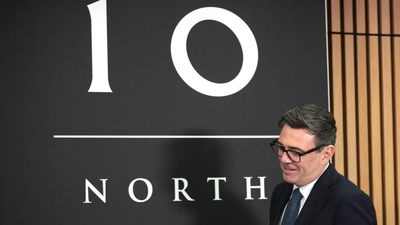
British Prime Minister Andy Burnham officially opened his newly created Northern Office
LONDON: British Prime Minister Andy Burnham officially opened his newly established Northern Office on Friday, promising “a different way of running Britain” as he attempts to end decades of centralization of power over England in London.Burnham, who replaced Keir Starmer as Prime Minister on Monday, at the unveiling of No. 10 North in the north-western city of Manchester, pledged that energy would “flow” away from the ruling London borough of Whitehall to stimulate economic growth. “It’s not just a new office,” he told staff at the downtown location. “This is where Whitehall meets the rest of the country.”The former Greater Manchester mayor says the booming city region – which has outperformed Britain’s national average in various areas, including economic growth – provides a model for other parts of the country.
He aims to work from No. 10 North at least once a week, dismissing criticism that it is a “short-lived gimmick”. “This creates a sense of a more balanced country and that big things can be done from here,” Burnham insisted.However, devolution experts seem unconvinced. Academic and political consultant Alan Trench told AFP that “deconcentration” is “something that is done even in highly centralized countries and does not in itself mean any transfer of power.”
“At the extreme, it transfers public sector jobs and the lives and incomes of those who hold them.”The United Kingdom – which includes England, Scotland, Wales and Northern Ireland – saw significant constitutional reforms in the late 1990s that led to the creation of devolved parliaments in Edinburgh, Cardiff and Belfast. London also got a directly elected mayor and a board of scrutiny. But experts say England itself remains one of the most centralized countries in Europe despite the creation of some regional mayors and other bodies in the past decade.
“Nowhere in England is there any delegated authority to make law,” Trench noted.Nicola McEwen, a professor at the University of Glasgow, said English devolution was “highly asymmetric”, hampered by London which largely saw it as something “happening elsewhere”.Burnham has tested the limits of the current system during his nine years as Mayor of Manchester. Now in London, Johnson has ordered departments, including the Treasury, to make “targeted transfers of cross-cutting strategic functions” to No. 10 North, a minister told parliament this week.McEwen said giving No. 10 North a strategic role was “positive” but success would still depend on Whitehall agreeing to co-operate. However, Michael Keating, a professor of politics at the University of Aberdeen, noted: “It is a profound irony that to deal with centralisation, you create a central government department that will decide exactly who gets what.” Under a “real” mandate, he said, you “stay out of their way.”Others pointed out that the transfer of civil servants was neither bold nor innovative. Burnham’s spokesman admitted this week that around 80,000 government employees already work in northwest England. Burnham, who met nationalist leaders in Scotland and Wales on Thursday, said little about further devolution, other than ruling out support for independence referendums.(This is an AFP story)