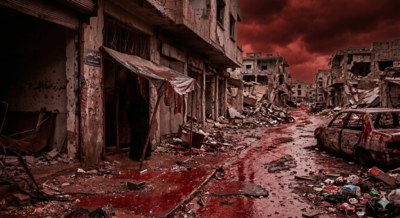
Incidents of “blood rain” in times of war usually arouse fear and many unfounded stories and speculations. This phenomenon is especially common during times of war and in war-torn areas, especially when the sky turns red and it appears that it is raining blood.
However, the real explanation for this phenomenon is very simple and not very scary. The phenomenon of red or “blood” rain has been around for many years and has been recorded throughout history and around the world. The real explanation for this phenomenon is completely natural and not scary at all.
What is it Bloody rain : Find out the science behind it
Blood rain refers to rain that appears red or reddish-brown in color. According to the UK Met Office, “blood rain” occurs when “red-colored dust or particles mix with the rain.”
The color may range from bright orange to dark red, depending on the amount of particles present in the rain. Rain is not actually made of blood, but of water and small solid particles.
Bloody Rain Explained: How dust and iron particles turn rain red
According to the research published in the International Journal of Astrobiology, the main cause of bloody rain is dust in the atmosphere. High winds, storms, or explosions may blow dust into the atmosphere at great heights.
- Dust particles act as nuclei for the formation of water droplets
- When rain falls from the sky, its particles fall with it
- If the dust is rich in iron, it gives the rain a reddish color
Scientists have found that iron oxide, the same compound that makes rust red, is the main cause of the red color in rain. Sometimes, the red color may be the result of algae spores.
Why is bloody rain reported in war zones?
Environmental factors may also contribute to the emergence of this phenomenon in times of conflict. Explosions, heavy vehicle movement, and ground damage may create a large amount of dust present in the atmosphere.
- Bomb explosions may cause particles to rise into the atmosphere
- Dry and damaged lands may create particles
- Smoke and ash may combine with clouds
Precipitation may wash away atmospheric particles, resulting in the phenomenon of red rain, which may appear to be directly related to conflict events, when in fact the science involved is the same as that which occurs during natural events.
Historical and modern notes on rain of blood
Blood rain has been documented for thousands of years. It was considered a bad omen. The occurrence of blood rain has been clearly documented in history.
However, science has now revealed the reason for the bloody rain.According to the BBC, dust from deserts such as the Sahara can travel thousands of miles and join rain clouds, resulting in bloody rain. In some cases, as in Morocco, microorganisms were the cause.
Is bloody rain dangerous: know the truth
In most cases, blood rain is considered harmless. It may leave stains on objects or vehicles, but in no way poses a serious health threat.
According to scientific explanations, it is “a natural process between the Earth’s surface and the atmosphere.”According to scientific explanations, blood rain is just “a natural atmospheric process that involves dust embedded in water droplets.” While blood rain may seem like a bad omen, especially in war-torn countries, its explanation is based on simple scientific foundations. It is in no way a harbinger of danger or anything supernatural, but a unique display of the power of nature, especially in relation to dust, wind and rain. It may seem more serious in war-torn countries, but its interpretation remains the same, a reminder that sometimes, even in the most troubling circumstances, there is a reasonable explanation for things in nature.