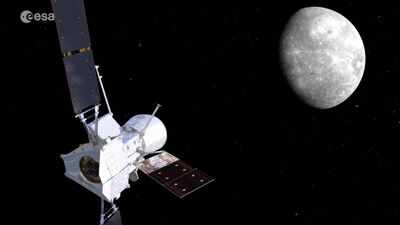
For most space missions, launch is the key moment. For Pepe Colombo, the real breakthrough comes years later. After spending nearly eight years weaving the inner solar system, the Euro-Japanese spacecraft is now approaching the point it was designed to reach from the beginning.
As reported by the European Space Agency, in November 2026, Mercury is expected to finally catch the spacecraft in orbit, ending one of the longest and most carefully managed planetary journeys ever. The wait was deliberate, not unexpected. Traveling to the closest planet to the Sun requires an approach unlike almost any other destination in space, requiring frequent gravitational assistance and constant adjustments rather than direct flight.
Once BepiColombo is settled into orbit, scientists will begin a new chapter in the exploration of Mercury, a planet that has remained surprisingly unfamiliar despite being in Earth’s cosmic neighborhood.
Why is Mercury still one of the least explored planets?
Mercury has never attracted the steady stream of missions seen on Mars or even Venus. Its close location to the Sun makes each visit technically demanding, leaving astronomers with only a handful of close encounters over the past five decades.
The first came via NASA’s Mariner 10 spacecraft during the mid-1970s. Those flights provided humanity’s closest detailed views of the scorched world, but were never intended to put a spacecraft into orbit. Decades later, NASA’s MESSENGER mission changed that by orbiting Mercury between 2011 and 2015, changing understanding of its geology, magnetic field and chemical composition.BepiColombo is now only the third mission to reach Mercury and only the second designed to orbit the planet, making its arrival an important addition to the surprisingly short history of exploration.
The unusual path to the innermost planet in the solar system
Mercury may appear closer than Mars on a map of the solar system, but distance alone tells little of the story. Any spacecraft heading toward the Sun gathers at tremendous speed as it approaches solar gravity. This excess speed becomes the main obstacle.Instead of racing directly toward Mercury, BepiColombo spent years doing almost the opposite. The mission repeatedly slowed itself down through carefully planned sequences of planetary encounters.
A flyby of Earth, two close-bys of Venus and six encounters with Mercury gradually reduced the spacecraft’s speed. Meanwhile, its ion propulsion system provided a continuous but gentle boost, making small corrections over thousands of hours rather than relying on powerful bursts.The result was a journey defined by patience rather than speed.
How BepiColombo was designed
Although typically described as a single spacecraft, BepiColombo actually began its mission as a group of three connected spacecraft.The mercury transport module carried out the mission through interplanetary space while providing the ionic thrust necessary during the long cruise. Attached above are two independent science orbiters that will eventually separate once Mercury takes over the mission.The European-made Mercury Planetary Orbiter will focus on the planet itself, examining its surface, internal structure and geological history.
Besides, Japan’s Mio spacecraft has a different mission. Instead of looking down at Mercury, the spacecraft will study the planet’s magnetic environment, studying the interaction between Mercury, the solar wind, and surrounding charged particles.Simultaneous operation gives scientists the opportunity to observe the planet and surrounding space at the same time, something previous missions have not been able to achieve.
How engineers kept the mission on track
The original arrival schedule has not changed.During 2024, engineers identified an unexpected decline in the performance of the spacecraft’s electric propulsion system. Investigations attributed the problem to electrical currents affecting the power distribution system linked to the spacecraft’s solar panels.The reduced thrust meant that the current flight plan could no longer deliver the spacecraft to Mercury orbit on schedule.
Mission specialists redesigned the remaining trajectory, taking greater advantage of Mercury’s gravity during subsequent flybys to compensate for the weaker thrust.The modified trajectory maintained the mission’s scientific objectives, although it delayed orbit insertion by approximately a year. Instead of arriving in late 2025, BepiColombo is now expected to complete the process in November 2026.
How BepiColombo will enter orbit
The mission crossed another important milestone during 2026 when it completed the main phase of ion-powered sailing.Unlike missions that perform a dramatic braking maneuver using a large chemical engine, BepiColombo’s arrival unfolds more gradually. Small thrust adjustments continue as Mercury’s gravity slowly takes over. The spacecraft will enter a temporary polar orbit before jettisoning the transfer module.Only then will the two science probes separate and begin moving toward their individual operational paths around the planet.
Their full science program is expected to begin during 2027 after completion of operation and orbit modifications.
Mercury still maintains many unanswered questions
Despite decades of research, Mercury still mystifies planetary scientists.Its massive iron core occupies a much larger proportion of the planet than any other rocky world in the solar system. The causes remain uncertain, with several competing theories trying to explain how this unusual interior design evolved.Mercury also has a global magnetic field despite its relatively small size. How this magnetic field survives for billions of years remains an active area of research.Perhaps the biggest surprise lies near the poles. Although Mercury experiences some of the highest surface temperatures in the solar system, its permanently shaded craters appear to be able to maintain water ice because sunlight never reaches their floors. Understanding the origin and stability of those frozen sediments is one of the goals that awaits BepiColombo once it begins its scientific observations.