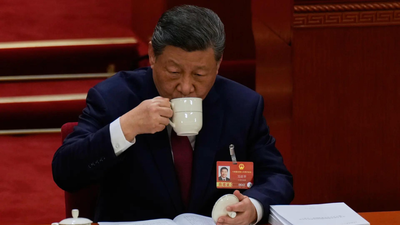
Chinese President Xi Jinping (archive photo)
DHAKA: China on Thursday said it was “determined” to build an economic corridor with Bangladesh and Myanmar, but remained open to “other countries” to join its “transnational initiative” – a project on India’s eastern flank that reflects the strategic role of the China-Pakistan Economic Corridor on its western border.The corridor – which was discussed during Bangladeshi Prime Minister Tariq Rahman’s recent visit to China – proposes enhancing connectivity, especially multimodal transport links from China’s Kunming to Bangladeshi ports, including Mongla, for which Dhaka, after canceling a deal with India, handed over to Beijing an economic zone development contract. “Dhaka and Beijing also agreed to explore a 2+2 dialogue mechanism on diplomacy and defence,” Chinese Ambassador to Bangladesh Yao Wen told reporters.Regarding the proposed corridor – which, if implemented, would give China access to the Bay of Bengal much like the China-Pakistan Economic Corridor does to the Arabian Sea – Yao said the idea of building such a project is not new. “There have been discussions about the Bangladesh-China-India-Myanmar Economic Corridor, but there has been no progress,” he said, referring to a plan abandoned in 1999 that proposed connecting the countries via road, rail, water and air.“This cooperation (between China and Bangladesh) is not the end of the game,” he added.
We are open, and we welcome other countries if they are willing to join. But it is up to them to decide whether they want to be part of it or whether they prefer to wait.”Relations between China and Bangladesh have been on the mend since 2024 – when Sheikh Hasina was ousted as prime minister – with the two sides engaging in several crucial initiatives, including defense – some of which such as the Teesta River restoration project, reports of Chinese assistance in developing the Lalmonirhat airbase near India’s eastern border, an agreement to set up a drone manufacturing and technology transfer factory in Dhaka, and a Mongla port contract that caught New Delhi’s attention.